





Schedule a Call Back


Schmersal launches Electromechanical Solenoid Interlock 2.0
 Communication Feature
- Apr 08,25
It doesn’t always have to be electronic. When selecting solenoid interlocks, an electromechanical switching device can be either sufficient or even better, depending on the application profile.
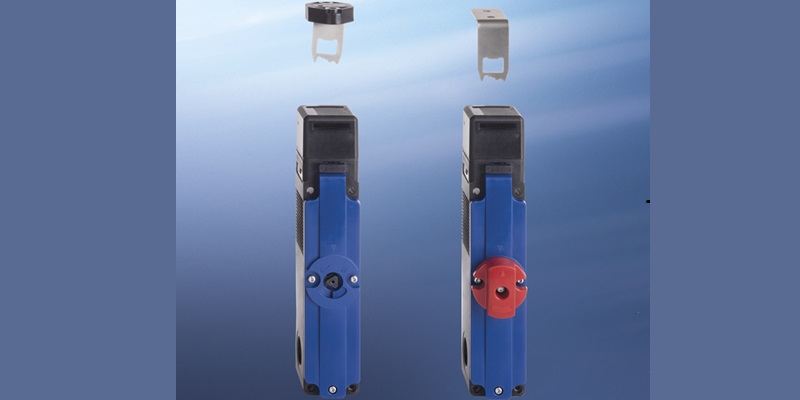
The task is clear:
solenoid interlocks are designed keep a guard door locked until a hazardous
overrun movement has come to a halt. Varied types of solenoid interlock have
this same basic principle in common. Manufacturers, like the Schmersal Group, have
more than just one series in their range – Schmersal has eight, in fact, each
with its own specific application profile (Figure 1).
Slimline design, good integration

The AZM150 series, one of
the newer types of solenoid interlock, is now available as a fundamentally
overhauled version and is aimed at users looking for a more slimline design
(Figure 2). It is suitable for mounting on standard 40 mm profile systems as
well as for mounting on conventional machinery enclosures, particularly those
with smaller guard doors. The AZM150 has only a small installation footprint
and can be easily integrated into the surrounding structure, thus having no
impact on machine loading and unloading. The locking force of 1,500N is also
perfectly adequate for common applications in mechanical engineering.
When costs play a role
Another criterion is the
desire for a cost-effective solution for a maximum safety level of PL d/Cat 3.
This level is achieved just as efficiently with the electromechanical AZM150 as
excellent tamper protection with coding level ‘High’. At this level, the
designer or machinery builder benefits from needing to implement fewer additional
measures in accordance with ISO 14119 to guard against tampering, such as inaccessible
or concealed mounting. This makes the design ‘leaner’ and more straightforward indirectly
being cost-effective.
Wide range of uses

A notable feature of the AZM150 is its actuator head, which can be rotated by 4x 90°, rather than being bolted in place, and locked easily by simply putting the enclosure cover in place. The version with integrated eight-pin M12 metal connector also enables rapid connection to the safety logic and connection to the failsafe Schmersal ‘Safety Fieldbox’. This makes this series extremely versatile. The combination option with different actuators for different installation situations is also a perfect match. The range includes straight and angled actuators for sliding doors, as well as an adjustable movable actuator for revolving doors. The extensive range of accessories includes; mounting plates, locking tongs and an emergency release (from the outside) as well as auxiliary release and escape release (from the hazard zone) help to ensure optimal customisation to the individual application. In the event of installation on security fences or heavy doors, the corresponding DHS150 door bolt can also be used (Figure 3).
Less can be more

If the features mentioned
here fit the profile (spatially and in the figurative sense), the user has no need
for an electronic solenoid interlock and would be better off using the electromechanical
AZM150. Exclusion criteria are both a required performance level of PL e/Cat 4 and
the desire for a connection to safety-related bus systems (ASi Safety at Work),
so anyone who needs these features should consider the range of electronic solenoid
interlocks, such as the AZM40 (Figure 4). As the world’s smallest electronic
solenoid interlock, it is even more compact, but has a higher price due to the
integrated electronics.
Simple actuating via standstill monitor

Each interlock has an
evaluation unit and standstill monitors, which issue the signal to unlock as
needed, have become a firmly established component for this. An appealing model
that fits well with the AZM150 is the SSW 303HV, a universal failsafe
standstill monitor that works without sensors (Figure 5). This means that the
machine designer of the machine need not intervene in the surrounding construction.
The safety module is connected directly to a three-phase motor and measures the
frequency of the induced voltage, at rated motor voltages of up to 690V. The
enable fields close as soon as the motor comes to a halt.
Not only for occupational safety

Previous applications of
the AZM150 are wide and varied and include packaging machinery with up to 20
guard doors. Here, users benefit most particularly from the more attractive costs
when compared to electronic solenoid interlocks and from the flexibility offered
by the toolless rotating actuator head (Figure 6). For some applications, the
reason for using the AZM150 is not the safety of machinery, but process safety,
which is typical for solenoid interlocks in general. This means that no hazardous
overrun movement is anticipated. Instead, the goal is to prevent the operator from
interrupting the process by opening the guard door, a process that can only
then be restarted through complex measures (resetting to zero, calibration,
releasing production goods due to abrupt halts, etc.). For situations like
these, the AZM150 is appropriate, which operates according to the open-circuit
current principle instead of the closed-circuit current principle.
Improvements in detail
Schmersal is currently in
the process of launching an overhauled version of the AZM150, which differs
from its predecessor in terms of the many design improvements. An expansion of
the range and accessories for this universal electromechanical solenoid interlock
is planned for the near future.
-------------------------------------------------------------
About the author:
Marco Kiederle, Product
Manager-Safety Technology, Schmersal
Group, Wuppertal.
Related Stories
Automation & Robotics
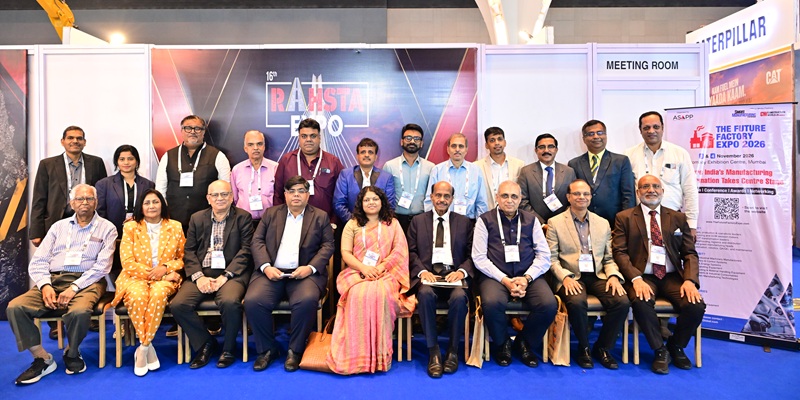
Future Factory Expo CXO Roundtable Charts Smart Transformation for SMEs
During the roundtable, hosted by Smart Manufacturing & Enterprises (SM&E) and The Future Factory Expo 2026, industry leaders outlined how SMEs can use practical digitisation, automation, skilling an..
Read moreAutomation & Robotics
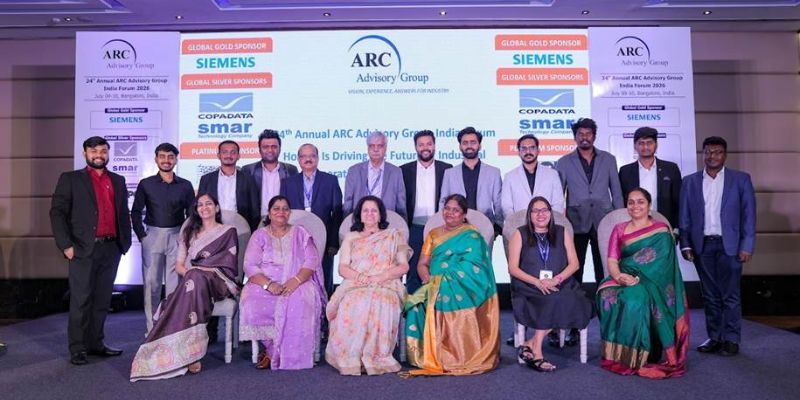
ARC India Forum Spotlights AI-Led Industrial Transformation
ARC Advisory Group’s 24th India Forum brought together 300-plus leaders to examine how AI is transforming industrial operations, manufacturing and supply chains.
Read moreElectrical & Electronics

IESA Backs Rs 625 billion PLI 2.0 for Electronics Manufacturing
IESA has welcomed the Rs 625 billion PLI 2.0 scheme, citing its potential to sustain manufacturing growth and advance India’s US$400 billion electronics goal.
Read moreRelated Products

Grey Polka Dash Board Covers
INDUSTRIAL SAFETY & SECURITY SYSTEMS
Elegant Auto Accessories offers a wide range of grey polka dash board covers.
Fire Protection - Industrial Sirens
INDUSTRIAL SAFETY & SECURITY SYSTEMS
Amit Safety Enterprises offers a wide range of fire protection industrial sirens.
Read more
Fire Alarm Sysytem
INDUSTRIAL SAFETY & SECURITY SYSTEMS
Nayakson Security Systems is offering a range of fire alarm, intrusion alarm and gas alarm systems.
latest News
Subscribe to iNoW

For Industry News on WhatsApp, Give a Miss Call on: +91 84228 74016