





Schedule a Call Back


Transforming India’s SMEs: From Domestic Players to Global Competitors
 Articles
- Mar 30,26
India’s manufacturing ambitions hinge on SMEs scaling from domestic strength to global competitiveness. Capability, quality, finance and trust will determine how effectively they integrate into global supply chains.

India’s ambition to emerge as a global manufacturing powerhouse rests heavily on its SMEs. As the country targets a sharp rise in exports, these enterprises are expected to transition from strong domestic players to globally competitive manufacturers integrated into international supply chains.
However, this transition is far from straightforward. It requires not just scale, but a shift in how SMEs approach technology, quality, financing, and organisational thinking. Insights from industry leaders highlight where Indian SMEs stand, and what must change.
From adoption to understanding
Across the SME landscape, technology adoption has accelerated in recent years, driven by the need to improve productivity and compete globally. However, the discussion highlighted that adoption alone is not enough, what matters is how deeply that technology is understood and integrated into operations.
Many SMEs invest in advanced machinery or processes without a clear roadmap for utilisation, leading to suboptimal outcomes and limited long-term gains.
Dr Umesh Mhatre, Managing Director, Surface Modification Technologies Pvt Ltd pointed out, ‘I think most of our SMEs are adopted without understanding what they are adopting. That's the biggest problem that I see that most of the technology that is being adopted couldn't see a longer term especially on the mechanical side and mechanical engineering side.’
This gap between adoption and understanding often prevents SMEs from extracting full value from their investments. For capability to truly evolve, technology must be aligned with long-term strategy and continuous improvement.
As SMEs move beyond domestic markets, they encounter a more demanding ecosystem where quality alone is not sufficient. Global markets require strict adherence to standards, robust systems, and consistent performance across the value chain.
One of the biggest gaps lies in how products are designed and developed. Many SMEs still treat compliance as a final step rather than a starting point.
Manish Poudwal, Chairman & Managing Director, Subtronics India Pvt Ltd highlighted this challenge, ‘Now what happens unfortunately for SMEs in India which we would also like to get them up is the product is designed and later on we see how we also consider which standard will fit in. So that is the biggest problem instead of doing that if we imbibe these standards right at the design stage.’
Embedding standards at the design stage ensures reliability, reduces rework, and aligns products with global expectations from the outset. In addition, SMEs must strengthen supply chain systems, documentation practices, and service frameworks to build credibility with international buyers.
The mindset shift
Beyond technology and systems, the transition to global markets is fundamentally a shift in mindset. SMEs must redefine their view of markets, competition, and growth.
Operating successfully in domestic markets often creates a comfort zone, but global competitiveness requires a broader perspective—one that anticipates diverse customer expectations and operates with higher precision.
This shift also involves taking calculated risks—investing in international exposure, participating in global exhibitions, and building brand presence in new markets. Without this change in thinking, SMEs remain confined to local opportunities.
Srinivasan R, Founder Director, AIRA Consulting explained, ‘If you have to be in the global market, you have to think global. The first mindset is, the entire ownership team starts talking about, we have to be in the global place. It's okay to be in Thane and selling it to Vasai, but you have to start thinking about Delaware, you have to start thinking about Riyad, you have to start thinking about Muskat.’
Finance as a Growth Enabler
Even when SMEs build capability and intent, growth is often constrained by one critical factor—working capital. Manufacturing businesses, in particular, face long payment cycles and liquidity pressures that can limit expansion.
Traditional financing models, which rely heavily on collateral, often restrict SME access to capital. This is where platforms like TReDS have begun to play a transformative role.
TReDS has enabled SMEs to unlock working capital by financing receivables, reducing dependence on traditional lending structures. The scale of adoption reflects its growing importance:
‘Access to financing is the most important for any MSME, SME who's building a business. Even after you do all of this, if you don't have the cash flow support and the working capital support, then we have seen many businesses fail at all levels.’ emphasised Rajeswari Kesavan, Head of Financial Institutions & Strategic Initiatives, RXIL.
‘In 2019 March, TReDS did 23 billion. This year, March 26th, RXIL will probably do about 1200 billion. And collectively, TREDS platforms have financed about 8 trillion till date cumulatively’she further added.
This shift towards cash-flow-based financing allows SMEs to leverage the creditworthiness of larger buyers. As global trade introduces additional risks such as currency fluctuations and delayed payments, such mechanisms become even more critical.
Data, risk and the new definition of trust
Global supply chains today operate on transparency and data. Decision-making is increasingly driven by analytics rather than relationships.
For SMEs, this means that every aspect of their operations—from financials to compliance—must be visible, structured, and verifiable.
Mohan Ramaswamy, Co-Founder & CEO, Rubix Data Sciences explained, ‘Everybody wants to make it extremely data and intelligence driven process where basis data and insights that they're able to derive is what will eventually lead to decision, either in favor or against.’
This shift places new responsibility on SMEs to maintain high-quality data and ensure transparency. The ability to demonstrate reliability through data is becoming central to building trust with global buyers, lenders, and partners.
Strengthening the foundations
While SMEs are making progress in capability and financing, foundational challenges continue to impact scalability. Standardisation, infrastructure, and operational discipline remain areas of concern.
Alignment with global standards is essential not just for compliance, but for communication—ensuring that products and processes are understood and accepted internationally.
Dr Umesh Mhatre, Managing Director, Surface Modification Technologies Pvt Ltd noted, ‘I think all these three terms are very, very important standard because that is the language the rest of the world understand and we neglect most of the time or SMEs neglect because of the way we work, the traditional way.’
Infrastructure limitations, particularly in smaller industrial clusters, also restrict automation and process improvement. Addressing these gaps is essential for SMEs to compete at a global level.
Designing for quality, not cost
In international markets, quality cannot be an afterthought. It must be embedded into the product from the very beginning.
For SMEs, this means moving away from inspection-led quality control towards design-led quality assurance, where performance, durability, and reliability are built into the product.
This approach not only improves product outcomes but also reduces long-term costs, enabling SMEs to maintain competitiveness without compromising margins.
Manish Poudwal, Chairman & Managing Director, Subtronics India Pvt Ltd, stated, ‘From our experience at Subtronics, we've seen the answer actually lies in designing for quality rather than designing for inspection and then after inspecting it you improve your quality.’
India’s SMEs are central to the country’s manufacturing ambitions. Their transition from local enterprises to global players will define India’s export trajectory.
The path forward requires a combination of capability, financial resilience, structured systems, and a global mindset.
For SMEs that align with these principles, the opportunity is not just to grow—but to lead in the global manufacturing ecosystem.
SME Conference
SMEs
MSMEs
Indian Manufacturing
Manufacturing
global manufacturing
Umesh Mhatre
Surface Modification Technologies
Manish Poudwal
Subtronics India
Srinivasan R
AIRA Consulting
Rajeshwari Kesavan
RXIL
Indian SMEs
TReDS platforms
Related Stories
Smart Manufacturing
Improving Manufacturing Efficiency with the Right Flow
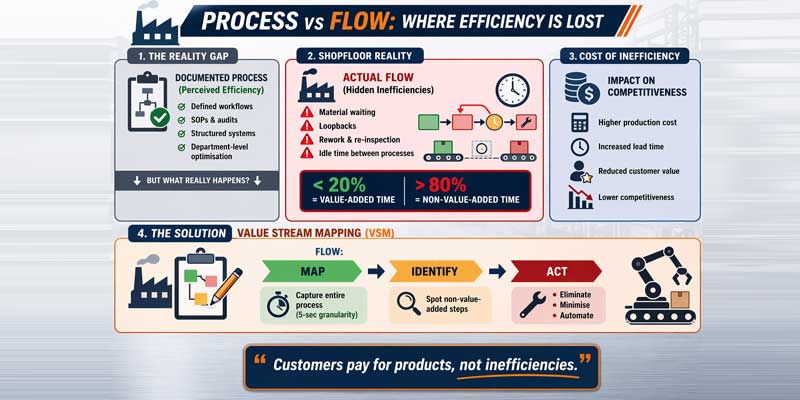
Often, the gap between documented processes and actual workflow leads to significant inefficiencies, with non-value-added time eroding competitiveness despite well-defined systems. In this month's c..
Read moreAutomation & Robotics
PPPA 2026: Automation takes centre stage in India’s process industry
India’s process industries are accelerating towards automation, AI and cyber security. Industry leaders at the ISA forum discussed smarter factories, skills gaps and India’s next growth phase.
Read moreAutomation & Robotics

Hannover Messe 2026 Showcases AI, Automation and Industrial Resilience
Hannover Messe 2026 drew 110,000 visitors, highlighting AI, automation, robotics and energy solutions as industry leaders called for faster reforms and stronger competitiveness
Read moreRelated Products
Compact Fmc - Motorum 3048tg With Fs2512
INDUSTRIAL AUTOMATION & TECHNOLOGY CONSULTANCY
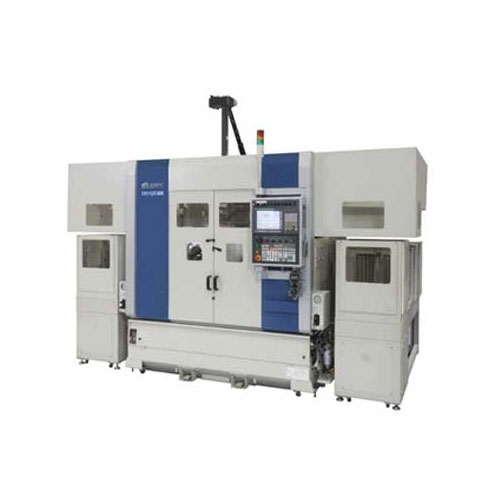
Meiban Engineering Technologies Pvt Ltd offers a wide range of Compact FMC - Motorum 3048TG with FS2512.
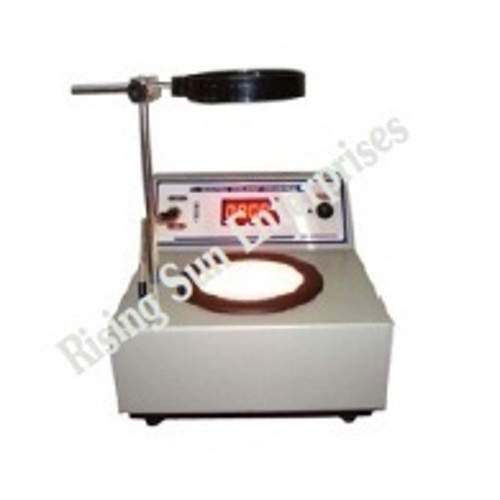
Digital Colony Counter
INDUSTRIAL AUTOMATION & TECHNOLOGY CONSULTANCY
Rising Sun Enterprises supplies digital colony counter.

Robotic Welding SPM
INDUSTRIAL AUTOMATION & TECHNOLOGY CONSULTANCY
Primo Automation Systems Pvt. Ltd. manufactures, supplies and exports robotic welding SPM.
latest News
Subscribe to iNoW

For Industry News on WhatsApp, Give a Miss Call on: +91 84228 74016