






Schedule a Call Back


Why Electronic Components Are Central to India’s Electronics Ambitions
 Articles
- Feb 04,26
India’s electronics push is shifting decisively from assembly to components, backed by the Union budget's higher ECMS outlay and ISM 2.0 to deepen value addition and resilience. The promise is real, but without long-term policy stability, design capability and testing ecosystems, the risk of remaining an assembly-heavy, low-value hub persists, says Rakesh Rao.
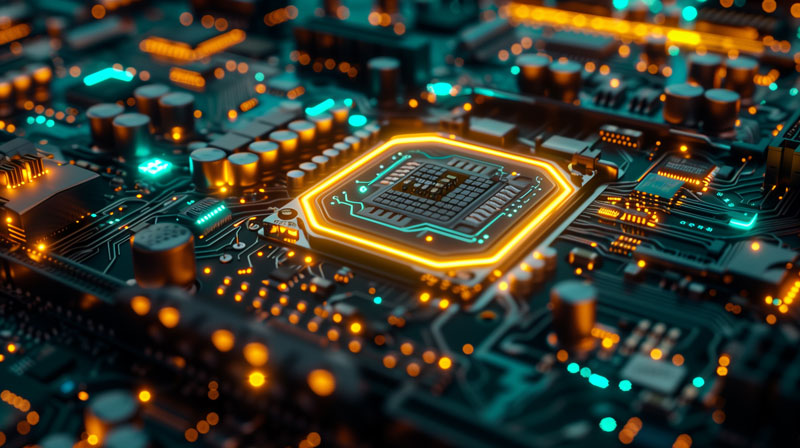
The Union Budget for FY2027, announced by Finance Minister Nirmala Sitharaman on February 1, 2026, has sharpened India’s electronics push from headline assembly numbers to the harder work of deepening indigenous capability. The outlay for the Electronics Components Manufacturing Scheme (ECMS) has been raised to Rs 400 billion from Rs 229.19 billion, signalling a stronger commitment to building the domestic component backbone that determines value addition, resilience and export competitiveness. The Budget has also proposed India Semiconductor Mission (ISM) 2.0 to expand capabilities across semiconductor equipment and materials, full-stack Indian IP design, and supply-chain fortification. And to deepen value addition in consumer electronics, it has proposed an exemption of basic customs duty on specified parts used in the manufacture of microwave ovens.
These moves are timely. India’s electronics industry is entering a decisive phase. After a decade of rapid gains driven largely by assembly-led manufacturing—especially in mobile phones—the focus is shifting to the deeper, more difficult layers of the value chain: electronic components, sub-assemblies, materials, testing ecosystems and design capability. The approval of multiple projects under ECMS in late 2025 and early 2026 reflects a growing policy recognition that assembly alone cannot sustain India’s ambitions in global electronics supply chains. To become a durable manufacturing hub—and a reliable exporter under an increasingly volatile global order—India must localise the components that carry the highest strategic and economic weight.
Strong growth, structural vulnerability
The headline growth story is undeniable. Electronics manufacturing output in India has grown sixfold over the past decade, rising from $ 21.8 billion in FY2015 to $ 129.9 billion in FY2025. Exports increased even faster, from $ 4.4 billion to $ 38.56 billion over the same period, with electronic goods becoming India’s third-largest export category in FY2025. Yet this momentum masks a structural weakness: imports of electronic components stood at $ 36.8 billion in FY2025, nearly offsetting export gains. This is why the next chapter is no longer about scale alone. It is about composition—how much value is created inside the country, how resilient supply chains remain under stress, and whether India can graduate from being a preferred assembly base to becoming a serious manufacturing and design ecosystem for high-value electronics.
India has established itself as a global force in device manufacturing. The number of mobile phone manufacturing units expanded from two in 2014–15 to 300 by 2024–25, and India is now the world’s second-largest mobile phone manufacturer. Apple’s growing footprint is emblematic: its exports from India rose 42 per cent year on year to $ 12.8 billion in 2024. In the quarter ended September 2025, India overtook China to become the top smartphone exporter to the US, with a 240 per cent jump in smartphone manufacturing volumes. These are not incremental shifts; they indicate that India has built credible capacity in high-volume electronics production.
Policy has been central to this change. The National Policy on Electronics 2019, Production-Linked Incentive (PLI) schemes (large-scale electronics manufacturing and IT hardware), and infrastructure initiatives such as Electronics Manufacturing Clusters collectively reduced barriers to entry and catalysed capacity. Between FY2021 and FY2025, total FDI in electronics manufacturing stood at $ 4.07 billion, with $ 2.8 billion coming from companies under MeitY’s PLI schemes. The PLI scheme for large-scale electronics manufacturing has attracted $ 1.49 billion in investments so far, generating cumulative production worth $ 97 billion and exports of $ 53.4 billion, while creating 130,330 direct jobs as of June 2025. The second phase of PLI for IT hardware drew $ 86 million in investments, resulting in $ 1.42 billion worth of production and 5,056 direct jobs.
But the value-chain challenge is stark. High-value components—printed circuit boards (PCBs), camera modules, batteries, displays and precision sub-assemblies—remain largely imported. Most component imports came from China (nearly 40 per cent), followed by Hong Kong (over 16 per cent) in the first half of FY2025. In a world where export controls and technology restrictions are increasingly routine instruments of state policy, such dependency is difficult to defend as a long-term strategy.
Highlighting the limitations of an assembly-heavy manufacturing model, Sanjeev Keskar, Chief Executive Officer, Arvind Consultancy, says, "There is still a lot to be done on value addition. While India’s electronic product consumption story is strong, and PLI schemes have helped scale kit assembly across mobiles, IT hardware, consumer electronics and telecom, the value addition remains low as we are largely confined to assembly. In the long run, operating with less than 20 per cent local value addition will be a significant challenge. The government’s launch of initiatives such as ISM, ECMS and the DLI scheme should help improve local value addition in the coming years.â€
Why components decide value addition
Electronics manufacturing is fundamentally about ecosystems. Finished products capture only a slice of value if the underlying component layers are imported. Imported components expose manufacturers to currency swings, logistics shocks and trade restrictions, while limiting domestic value addition. Localising components changes the economics: it increases domestic content, improves export competitiveness, shortens supply chains and makes manufacturing clusters more attractive for global firms diversifying away from concentrated hubs.
Sanjay Huprikar, Chief Global Officer, Global Electronics Association, states, “We are operating in an environment of unprecedented geopolitical tension. On any given day, the news alternates between reports of new tariffs and announcements of fresh free trade agreements. The level of volatility is extremely high, and there is very little stability.†In such conditions, he argues, diversification becomes strategic, not optional: “The structural shift we are witnessing is a deliberate move toward diversification and resilience, with companies rethinking over-dependence on single geographies and investing in alternative manufacturing hubs.â€
The offensive case is value addition. Components determine manufacturing competence, supplier capability, process know-how and the ability to innovate. They also connect electronics to adjacent growth sectors—automotive, telecom, clean energy and infrastructure—where electronics content is rising sharply. Huprikar underlines the scale: “Our estimate places the global electronics industry at approximately $6 trillion in value. Twenty-five years ago, electronics accounted for less than 10 percent of a vehicle’s value. Today, even in internal combustion engine vehicles, electronics content exceeds 50 percent, and in electric vehicles it is even higher.â€
ECMS: Building the component backbone
ECMS is designed to address a structural weakness: heavy dependence on imported components. While India has made rapid gains in mobile phone assembly, most high-value components—PCBs, camera modules and batteries—continue to be sourced from abroad. ECMS seeks to correct this by incentivising domestic manufacturing of key components, sub-assemblies and supply-chain inputs—reducing import dependence, deepening value addition and improving resilience.
The third tranche of ECMS approvals covers 22 proposals, with projected investment of Rs 418.63 billion and expected production worth over Rs 2.58 trillion. Earlier ECMS tranches approved in October and November 2025 cleared 24 proposals with investments of over Rs 127 billion, indicating steady momentum. The first set of projects approved under the programme will receive grants worth Rs 55.32 billion ($ 626 million) under a $ 2.7 billion plan. In total, the scheme has received 249 applications from local and global companies, with proposed investment commitments of Rs 1.15 trillion (nearly $ 14 billion).
Sanjeev Keskar explains, “The ECMS is targeted at critical areas such as bare PCBs, passive components, camera modules, capital equipment, batteries and raw materials for component manufacturing. It is a well-designed scheme, and the response has been very encouraging, with 249 companies submitting proposals worth Rs 1.15 trillion. Components covered under the ECMS account for nearly 15 per cent or more of value addition in electronic products. If India’s electronics market reaches $400 billion by 2030, demand for these components alone will exceed $60 billion. This makes improving local value addition critical, while simultaneously opening up significant export opportunities.â€
Approved projects span 11 target segments. Five are bare components: PCBs, capacitors, connectors, enclosures and lithium-ion cells. Three are sub-assemblies: camera modules, display modules and optical transceivers, where value addition is materially higher than simple assembly. The remaining segments cover supply-chain materials such as aluminium extrusion, anode material and laminates, supporting both electronics and adjacent sectors such as automotive and telecom.
Among the biggest investments are three mobile enclosure projects worth over Rs 270 billion, nine PCB-related projects worth Rs 73.77 billion, and a lithium-ion cell project involving Rs 29.22 billion. The sequencing is pragmatic: build scale and reliability in foundational components and high-volume parts, then deepen into more demanding segments as supplier capability matures.
Huprikar offers a wider context for why components matter: “Of the projected $500 billion electronics industry by 2030, around $350 billion is expected to come from finished goods. The remaining $150 billion is expected from components—a segment that is still developing. For India to achieve sustainable and unhindered growth, it must reduce its dependence on imported components and build a robust domestic supply chain.â€
The next frontier: Design, testing and standards
Component manufacturing is necessary—but not sufficient. Long-term competitiveness hinges on design capability, testing infrastructure, certification ecosystems and workforce readiness. Without these, India risks remaining a low-margin manufacturing base—valuable for volume, but not indispensable for innovation.
Sanjeev Keskar elaborates, "Design is one of India’s core strengths, and indigenous design—both in chips and embedded electronic systems and products—is essential, as it can contribute nearly 30 per cent value addition. In a $400 billion electronics market, design alone could account for over $120 billion in value. With current schemes, much of the focus remains on low value–add manufacturing. Most raw materials continue to be imported, which means local value addition is still below 20 per cent, similar to what we see in mobile phones.â€
The implication is clear: component localisation must be complemented by sustained investment in technology development and product innovation.
Gaurav Lath, Joint Managing Director, Concord Control Systems Ltd, notes: “India’s electronics industry is entering a phase of structural maturity; the ecosystem is now moving beyond manufacturing scale towards system-level technology ownership. Component schemes enable this shift. The transition from assembly-centric growth to engineering-led value creation is essential. Component manufacturing involves long development and qualification cycles, and policy support makes such investments viable. Greater emphasis is needed on testing infrastructure and certification ecosystems. Deeper collaboration between industry and R&D institutions is essential to translate research into real-world applications.â€
Localisation is often framed as strategy; at factory level, it is about landed cost, working capital, reliability and lead times. Sanjeev Keskar explains, “Today, Indian electronics manufacturers source components from as many as 10 different countries. This creates a cost disadvantage of 4–5 per cent compared to China or other South-East Asian regions, driven by higher freight costs, foreign exchange exposure and inventory carrying costs. Localisation will clearly improve competitiveness.â€
Abhishek Malik, Executive Director, Calcom Vision Ltd, cautions, “India’s electronics industry is at a critical stage, with growth driven largely by short-term policy incentives and domestic demand rather than a fully developed manufacturing ecosystem. My biggest concern is that many schemes are valid only for five years, whereas electronics manufacturing is not a five-year business—it requires long-term investment in infrastructure, people and technology. Even in areas such as PCBs, key raw materials like laminates continue to be imported, meaning we are often only changing the form of imports rather than truly localising production.â€
The policy makers face a dilemma: “If you allow cheap component imports, local component manufacturers are discouraged. But if you restrict imports too much, finished goods become uncompetitive globally.†Malik’s conclusion is straightforward: “It has to be both, implemented in parallel.â€
Exports have surged—$ 37.6 billion in FY2025 by one data series and $ 38.56 billion by another government reference—but the next phase demands higher domestic content per dollar exported. Abhishek Malik argues, “There must be strong incentives to promote exports of electronic goods and components—China has been doing this consistently for nearly three decades. Without sustained export support, India risks remaining a low-margin assembly destination rather than evolving into a high-value manufacturing hub. While many countries are now looking to diversify their sourcing, India can capitalise on this opportunity only by significantly strengthening its domestic component ecosystem.â€
Moving from assembly to components also means moving from EMS-heavy manufacturing towards design-led, engineering-driven ecosystems where firms own more IP and supply more complex sub-systems. Malik states: “India is still overwhelmingly an EMS-driven industry. Around 95 percent of companies are doing basic assembly. ODM is growing, but very slowly due to lack of incentives for R&D and design-led manufacturing.â€
Electronics content is rising fastest in sectors that demand reliability and systems integration—mobility, infrastructure and mission-critical applications. That is where component ecosystems, testing and standards matter most. Nitin Jain, Joint Managing Director, Concord Control Systems Ltd, notes, “The next phase of growth will be driven by advanced control electronics and mission-critical systems. India is well positioned to emerge as a trusted global source for advanced electronic systems, particularly in infrastructure and mobility sectors.â€
Huprikar notes, “High-reliability segments such as aerospace and defence, medical electronics and high-end automotive demand extremely stringent standards—these are Class 3 products where failure is not an option. At the same time, mobile handsets will continue to be the dominant volume driver in India and are likely to remain so over the next five to ten years.â€
Trade architecture matters as India climbs the value chain. The India–EU FTA, signed on January 27, 2026, is often discussed in terms of market access and tariffs. For electronics and components, its relevance is structural: integration into global supply chains depends on predictable trade rules, regulatory alignment and the ability to serve high-quality markets consistently.
Lath says: “We are very encouraged by the India–EU FTA. It significantly lowers entry barriers for electronics exports and creates new opportunities for Indian companies. It can be a turning point.†But preferential access is not a substitute for capability. It is a multiplier once capability exists—when components, testing ecosystems, standards and design are competitive in cost, quality and speed.
The road ahead: Capability, not just capacity
India’s electronics components market is projected to reach $ 150 billion by 2030, while the overall electronics market is expected to scale to $ 500 billion. These numbers define the opportunity set; the question is how much domestic value India captures within it. Keskar sets a near-term marker: “Over the next five years, component manufacturing initiatives should help raise local value addition to over 30 per cent. The larger objective, however, must be to take local value addition beyond 50 per cent within the following five years, from the current level of less than 20 per cent, through sustained investment in technology, localisation and innovation.â€
ECMS and adjacent policies are attempting to correct the structural imbalance between finished-goods assembly and component manufacturing. The approvals—22 proposals in the latest tranche with Rs 418.63 billion of projected investment and over Rs 2.58 trillion of expected production, and nearly 34,000 jobs—demonstrate scale and intent.
Yet the harder work begins where incentives end: building supplier density, achieving first-time-right quality, creating testing and certification infrastructure, strengthening design-led innovation, and sustaining policy continuity long enough for component investments to mature. The Budget’s higher ECMS outlay, the push via ISM 2.0, and targeted duty rationalisation for consumer electronics parts point to an increasingly aligned policy stack. If execution matches intent, India’s electronics story can move from “made here†to “made and designed hereâ€â€”with components as the bridge between the two.
Electronics Components Manufacturing Scheme (ECMS)
electronics value addition
semiconductor ecosystem
import dependence
supply-chain resilience
design-led manufacturing
India–EU FTA
electronics exports
Sanjeev Keskar
Arvind Consultancy
Sanjay Huprikar
Global Electronics Association
Gaurav Lath
Concord Control Systems
Abhishek Malik
Calcom Vision
Nitin Jain
Concord Control Systems
Related Stories
Electrical & Electronics

IESA Backs Rs 625 billion PLI 2.0 for Electronics Manufacturing
IESA has welcomed the Rs 625 billion PLI 2.0 scheme, citing its potential to sustain manufacturing growth and advance India’s US$400 billion electronics goal.
Read moreRailways

Concord Associate Wins Rs 2,799 Mn KAVACH Order
Progota India has received a Rs 2,799 million Indian Railways order for on-board KAVACH 4.0 loco equipment.
Read moreElectrical & Electronics

Global Electronics Association Launches Policy Council
The new council will coordinate global advocacy across the electronics supply chain amid tariff, export control and investment pressures.
Read moreRelated Products

Ultra-slim Humidity/temperature Indicator With Large 4” Display
ELECTRICAL & ELECTRONIC EQUIPMENT
Countronics offers a wide range of ultra-slim humidity/temperature indicator with large 4” display – Model 7100-4W.
Read more
Integrated Electric Gripper S Series
ELECTRICAL & ELECTRONIC EQUIPMENT
IBK Engineers Pvt Ltd offers a wide range of integrated electric gripper S series.

Geared Electric Motors
ELECTRICAL & ELECTRONIC EQUIPMENT
Delco Fans Pvt Ltd offers single phase capacitor run and three
phase geared Instrument motors, totally enclosed face/foot mounted.
latest News
Subscribe to iNoW

For Industry News on WhatsApp, Give a Miss Call on: +91 84228 74016