








Schedule a Call Back


Manufacturing Strength Behind India’s Self-reliance and Global Positioning
 Articles
- Jan 26,26
India’s manufacturing sector is evolving from domestic self-reliance to global leadership, navigating a VUCA environment through strategic policy, capability building and infrastructure-led execution, outlines Sandip Chakroborty, MD, JCBL Limited (South), A JCBL Group Company.

Key Takeaways:
- India’s manufacturing sector is evolving from ‘Make in India’ to ‘Make in India for the world’, driven by stronger domestic capability, reduced import dependence and rising export confidence.
- A VUCA operating environment has shifted manufacturing focus from speed and cost to strategic decision-making, resilience and clarity of direction.
- Policy reforms, infrastructure development and technology adoption are enabling manufacturers to manage volatility, uncertainty, complexity and ambiguity more effectively.
- The sector is moving from a cost-led advantage to a capability-led model, positioning India as a reliable and value-added partner in global supply chains.
After strengthening domestic capability and reducing dependence, ‘Make in India’ is now powering India’s presence on the global manufacturing stage, evolving into ‘Make in India for the world’. Manufacturing today operates in a VUCA environment- marked by volatility, uncertainty, complexity and ambiguity - where conditions continue to evolve faster than traditional planning cycles can absorb. In such moments, progress is no longer defined by speed alone, but by the quality of decisions and the clarity of direction behind them.
A VUCA environment makes decision-making inherently more demanding. Volatility compresses timelines, uncertainty shortens visibility, complexity multiplies interdependencies, and ambiguity clouds long-term outcomes. Navigating such conditions requires more than operational excellence - it demands a strategic approach at every level.
In a VUCA world, strategy is not a function - it is the framework through which every decision must be viewed. Every decision - what we build, where we source, how we move, and whom we partner with - has to be intentional. Strategically planned; purposefully executed. This is precisely where India finds itself today. With the right balance of policy direction and manufacturing capability, the sector is already playing a significant role in the national economy, contributing close to 17 per cent of India’s GDP and placing the country among the top five manufacturing economies globally. As domestic manufacturing capacity strengthens, it is directly contributing to reduced import dependence and stronger export performance-reinforcing both self-reliance and economic growth.
What began as ‘Make in India’ is now steadily evolving into ‘Make in India for the world’- a transition driven not by intent alone, but by strategic execution across policy, industry, and infrastructure.
The global manufacturing landscape
Globally, manufacturing output remains a core pillar of economic activity, with multiple countries leading the pack, and India is among the top five. According to the United Nations Industrial Development Organisation (UNIDO), India is now the fifth-largest manufacturing nation in the world, accounting for about 3.2 per cent of global manufacturing output — positioning it ahead of several long-established industrial economies. Foreign investment into the sector continues to grow, with manufacturing FDI rising to over $19 billion in FY2024-25, reflecting global confidence in India’s industrial potential.
India’s manufacturing momentum
Together, these figures show that India is not just expanding its domestic capacity but also asserting itself as a reliable hub in the global manufacturing landscape. India’s manufacturing sector, today contributing roughly 17–18 per cent to the GDP, is on a path to reach a projected 25 per cent by 2030.
Policy reforms, production-linked incentive (PLI) schemes, and steady improvements in Ease of Doing Business have collectively strengthened the foundation. More importantly, the confidence in “Make in India” has matured from a slogan into a structural capability.
Navigating the VUCA challenges
Manufacturing today is shaped by forces well beyond the factory floor. Volatility, uncertainty, complexity and ambiguity are now embedded in how manufacturers plan, produce and compete — particularly in capital-intensive sectors such as mobility and heavy-duty applications.
Volatility: Volatility is most evident in raw material pricing, especially steel and other core inputs critical to heavy-duty manufacturing. Sharp price movements within short periods directly affect margins, working capital cycles and project pricing, pushing procurement and inventory planning into the strategic domain. To strengthen domestic availability and reduce exposure, initiatives like the PLI scheme for steel and auto components have expanded local capacity, with India’s crude steel production crossing 140 million tons, improving supply stability for manufacturers.
Uncertainty: Uncertainty arises from shifting trade policies, evolving emissions norms and changing demand patterns, particularly as mobility transitions toward cleaner technologies. These factors shorten planning horizons and complicate capacity decisions. Industrial frameworks such as FAME are supporting manufacturers in planning investments with greater confidence. India’s merchandise exports exceeding $ 430 billion reflect growing stability in trade-linked manufacturing.
Complexity: Manufacturing complexity has increased as supply chains span multiple geographies and compliance regimes. Disruptions at any point can impact production schedules, highlighting the need for resilient, integrated logistics. Manufacturers, logistics providers and port operators have invested in digital tracking systems, private freight terminals, multimodal warehousing and better demand forecasting, aligning their operations with the national logistics framework that has initiatives such as PM Gati Shakti and the National Logistics Policy. This combined push has helped bring India’s logistics costs down to around 8 per cent of GDP.
Ambiguity: Ambiguity stems from technology transitions such as electrification, hydrogen mobility and digital manufacturing, where timelines and cost structures are still evolving. To manage this, green hydrogen, advanced automotive technologies and Industry 4.0 adoption is enabling phased experimentation and domestic capability building. This approach allows manufacturers to adapt without overcommitting, keeping future pathways open while reducing investment risk.
Opportunities Arising for Indian Manufacturing
Amid the VUCA environment, there are various opportunities before Indian manufacturing sector:
Supply Chain Rebalancing: As global companies reassess concentration risk in their supply chains, manufacturing is shifting toward diversified and resilient sourcing models. This realignment has opened a significant window for India. In response, India’s expanding industrial corridors; improving logistics performance and policy consistency are enabling manufacturers to integrate into global supply chains not just as assembly hubs, but as value-added production partners.
Trade Integration and Market Access: Trade disruptions have pushed companies to prioritise predictable market access over pure cost arbitrage. India’s recent Free Trade Agreements with major countries are improving tariff structures and simplifying export pathways for manufactured goods. This has strengthened India’s export competitiveness across sectors such as automobiles, auto components and engineered products, contributing to merchandise exports crossing $ 430 billion.
Domestic Demand as a Strategic Anchor: While global supply chains are being restructured, India’s growing domestic demand provides manufacturers with a critical stabilising base. This strong home market allows manufacturers to scale operations, absorb volatility and invest in capability development, while also serving export markets. The combination of domestic scale and global opportunity is emerging as a key structural advantage for Indian manufacturing.
From Cost Advantage to Capability Advantage: Disruption has shifted the basis of competition from low cost alone to reliability, customisation and engineering capability. Indian manufacturers are increasingly leveraging this shift by offering application-specific solutions, faster development cycles and integrated services.
Manufacturing and the Nation’s Growth Story: Manufacturing growth and national growth are closely linked, and this connection is becoming increasingly evident. As the global landscape shifts and domestic demand expands, Indian manufacturers are finding opportunity on both fronts.
These opportunities come with challenges, particularly in a VUCA environment, but consistent policy direction, improving infrastructure and purposeful use of technology are helping industry navigate them with greater confidence.
The impact of Make in India is already visible on the ground, and the focus is now clearly evolving—towards building not just for domestic needs, but for global markets. Manufacturing is no longer a supporting pillar of growth; it is becoming one of its primary drivers.
As manufacturing continues to anchor both economic stability and global engagement, India’s position is becoming clearer: not only as a nation building for itself, but as one prepared to manufacture with confidence for the world.
About the authors:

Sandip Chakroborty is a visionary leader with over 26 years of experience driving growth and innovation in the technology sector. As the MD of JCBL South, he has transformed the company into a market leader known for its cutting-edge solutions in innovative engineering. Under his strategic foresight and hands-on approach, JCBL South has achieved record revenue growth year-overyear.
Make in India
Indian manufacturing
global manufacturing hub
VUCA environment
PLI schemes
Industry 4.0 India
manufacturing exports
Sandip Chakroborty
JCBL Limited
JCBL Group Company
Related Stories
Automation & Robotics
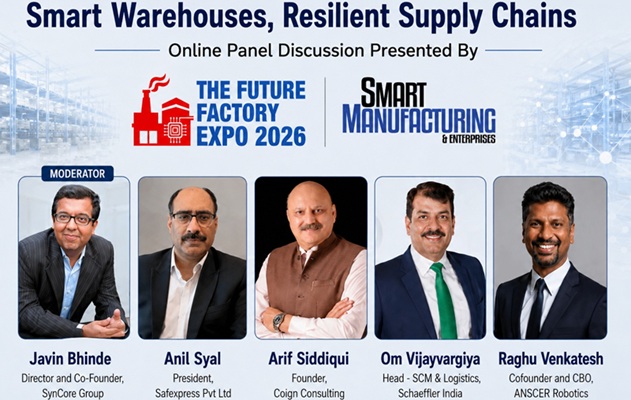
Future Factory Expo Webinar Series: Smart Warehouses for Resilient Supply Chains
In the run-up to Future Factory Expo 2026 (to be held on November 3-4 in Mumbai), Smart Manufacturing & Enterprises recently hosted the webinar exploring how automation, digitalisation, smart infras..
Read moreAerospace Defence
Tembo Global JV to begin UAV component production within 90 days
JR UAV Limited will start manufacturing specialised UAV components at Tembo Global’s Kashidkopar facility within 90 days, targeting at least Rs 1 billion in first-year revenue.
Read moreAutomation & Robotics
AI Emerges as Key Growth Driver for Indian Manufacturing Sector: PwC
PwC study reveals 59 per cent of Indian manufacturers see AI as key to strategic growth over the next five years.
Read moreRelated Products

Automotive Oil Pump
AUTO COMPONENTS & ACCESSORIES
Kalpak Auto Pvt Ltd offers a wide range of
automotive oil pump.
Tata Motors unveils facilities for development of Hydrogen propulsion tech
AUTO COMPONENTS & ACCESSORIES
Tata Motors, India?s largest automobile company, unveiled two state-of-the-art & new-age R&D facilities for meeting its mission of offering sustainable mobility solutions. The unveilings constitute of Read more
Tata Motors plans petrol powertrain for Harrier and Safari SUVs
AUTO COMPONENTS & ACCESSORIES
Tata Motors is in the process of developing a new petrol powertrain for its premium sports utility vehicles, the Harrier and Safari, as confirmed by a senior company official. Currently, these models Read more
latest News
Subscribe to iNoW

For Industry News on WhatsApp, Give a Miss Call on: +91 84228 74016