









Schedule a Call Back


How Trufrost & Butler Is Building India’s Foodservice Equipment Base
 Articles
- Jul 27,26
A flexible factory, a localisation roadmap and an export ambition define Trufrost & Butler’s manufacturing bet, writes Ashlin Rajan.
In a commercial kitchen, every degree matters; on a service floor, every minute of downtime carries a cost. Refrigeration and foodservice equipment have become critical to the speed, safety and consistency of India’s hospitality industry. In this landscape, Trufrost & Butler has built its Bhiwandi manufacturing facility around a defining question: can India produce globally benchmarked kitchen equipment without forcing operators to choose between expensive imports and unreliable low-cost alternatives?
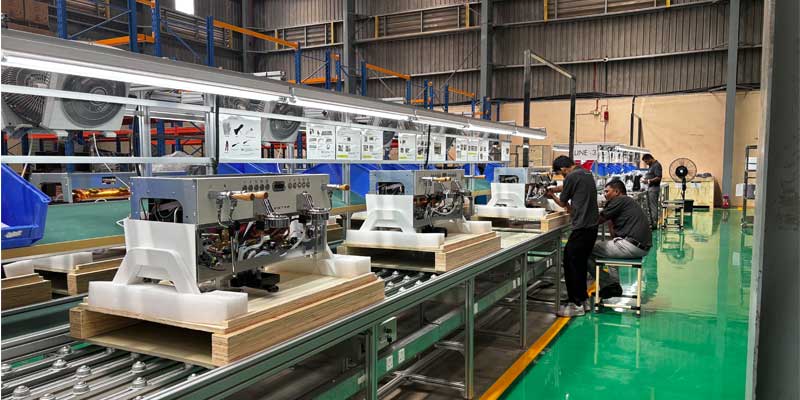
At the centre of that ambition is a 106,000 sq ft integrated facility designed to manufacture 400 machines per shift. Built around eight flexible production lines, the plant can handle multiple equipment categories through an assembly-led model, giving the company room to scale as demand evolves. More than a capacity expansion, Bhiwandi marks Trufrost & Butler’s transition from an import-driven business to a domestic manufacturing platform aimed at serving Indian kitchens and, eventually, global markets.
Bridging the market gap
That gap has shaped the company’s strategy. Neeraj Seth, Co-Founder & Managing Director, Trufrost & Butler, says the domestic market has long been “polarised between premium imported products from Europe and the US and low-cost, inconsistent-quality alternatives”. After eight years of building demand largely through imports, the company believes it has accumulated enough market scale across categories to move towards domestic production.
The transition matters because commercial foodservice equipment is not yet a single-category, high-volume business in India. Demand is distributed across refrigeration, preparation, cooking and other kitchen applications.
A flexible factory for a diverse market
Rather than design a conventional line around one product, Trufrost & Butler has created eight flexible production lines capable of handling different categories through an assembly-led model.
“The eight production lines allow us to manufacture multiple product categories through an assembly-based approach,” Seth says. “Different products can be produced on different days and different lines using the same production infrastructure.”
This flexibility supports an installed capacity of 400 machines per shift. Scale comes from the combined output of several categories rather than one dominant product. As volumes rise, the company plans to expand from eight lines to 16 and eventually to more than 20.
Building an integrated manufacturing ecosystem
The plant brings manufacturing, assembly, in-process inspection, final testing, quality-control laboratories, component storage, finished-goods warehousing and dispatch into one integrated operation. Mechanised material handling, organised storage and planned truck-docking arrangements are intended to reduce bottlenecks and improve control over the production journey.
Seth describes the plant as infrastructure designed for “the next two to three decades”. Barcode-based traceability, documented standard operating procedures, work instructions at production lines and structured testing processes form its operational backbone.
Global processes adapted for India
Instead of developing every manufacturing system independently, the company has drawn on international technology partners. Production teams have undergone overseas training, while technology transfers and knowledge exchange have introduced processes shaped by manufacturers with 30 to 50 years of experience.
“We have adopted globally recognised manufacturing practices from our international partners rather than reinventing our own processes,” Seth says. The objective is not simply to reproduce imported designs locally, but to adapt validated technologies for Indian operating realities.
Those realities can be punishing. Commercial equipment may operate in hot kitchens, tropical conditions and regions with unstable voltage. Electrical specifications and usage patterns also vary. The company says products are therefore adapted for these conditions, with an emphasis on energy efficiency, reliability and consistent performance.
Selected equipment is also being developed with smart capabilities such as IoT connectivity, programmable recipe settings and preventive-maintenance alerts, giving operators greater control while reducing avoidable downtime.
Compliance as a competitive advantage
Compliance is another pillar of the manufacturing push. More than 30 product categories are BIS-certified. A further 25 products were awaiting certification in the supplied timeline, which set July 2026 as the target; the material does not confirm that all approvals had been completed by then.
Trufrost & Butler also plans to pursue BEE star ratings for select categories, linking product development with measurable energy performance.
Reliability beyond the factory gate
For hospitality operators, certifications matter, but reliability is judged in service. A refrigeration unit or kitchen machine that fails during peak operations can disrupt revenue, food safety and customer experience.
Seth’s manufacturing argument therefore extends beyond the factory gate: dependable equipment requires repeatable production, accurate testing and responsive after-sales support. Local manufacturing can shorten parts availability and service response, but only when the supplier ecosystem develops alongside the plant.
Facility at a Glance
- 400 machines per shift
- 8 flexible lines, scalable beyond 20
- Barcode traceability and structured testing
- IoT-enabled smart equipment
- 30+ BIS-certified product categories
- BEE star ratings planned
Localisation beyond assembly
That is why localisation is a gradual roadmap rather than an immediate claim. The company currently combines assembly-based manufacturing with sourced components and plans to increase domestic content as specialist suppliers mature.
Seth compares this evolution with India’s automotive industry, where initial import dependence eventually gave way to a deep ancillary network.
“We have a clear roadmap for localisation,” he says. “We believe our industry can follow a similar path.”
The analogy is instructive, although commercial kitchens will develop at a different scale and pace. Refrigeration systems, stainless-steel fabrication, electronics, compressors and controls require distinct capabilities. Building a dependable vendor base will demand technical support, quality discipline and predictable demand—not merely procurement substitution.
Scaling with India’s hospitality demand
Demand, however, is strengthening. Seth says the company recorded 72 per cent year-on-year growth in the first quarter and approximately 50 per cent growth over the preceding 12 months.
India’s expanding network of hotels, restaurants, cafés, cloud kitchens and institutional kitchens is raising expectations around hygiene, throughput, energy use and uptime. Operators increasingly require equipment that is affordable over its lifecycle, not simply cheaper at purchase.
For now, the priority is to stabilise production, streamline operations and maintain quality as domestic volumes rise.
Preparing Bhiwandi for exports
The next phase is geographical. The company sees opportunities in Sri Lanka, Nepal and Bhutan, followed by the Middle East, Africa and Europe. Seth specifically identifies the UAE, Africa and Europe as focus markets, while stressing that the plant must first be fully prepared to operate as an export hub.
Carpediem Capital Partners’ backing provides growth support as the company expands capacity, product coverage and market reach. Yet capital alone will not determine whether Bhiwandi succeeds. The harder task is to establish a manufacturing culture in which global processes, Indian adaptation, supplier development, certification and service reinforce one another.
From factory investment to industry ecosystem
The facility’s real test will not be how many machines it can make on its best day, but how consistently it can deliver reliable equipment across categories, climates and markets.
If Trufrost & Butler can execute that model, Bhiwandi could help move India’s foodservice equipment sector from fragmented assembly towards a credible, technology-led industrial ecosystem of its own.
Neeraj Seth
Trufrost & Butler
Ashlin Rajan
commercial refrigeration
foodservice equipment
manufacturing facility
BIS-certified manufacturing
Make in India
refrigeration manufacturing
hospitality industry India
BEE star ratings
Related Stories
Machine Tools & Accessories

Advait Starts Ahmedabad Facility Operations
Advait Energy Transitions has commenced operations at its integrated Gangad facility in Ahmedabad, as Q1 FY27 consolidated revenue rose 48 per cent YoY to Rs 1.79 billion.
Read moreAuto & Auto Components

JSW Motors appoints Pankaj Doval as SVP – Corporate Affairs & Public Policy
Pankaj Doval will lead JSW Motors’ government, regulatory and policy engagement as the company prepares to launch new energy vehicles and scale up its Bidkin facility.
Read moreAerospace Defence

Tembo Global JV to begin UAV component production within 90 days
JR UAV Limited will start manufacturing specialised UAV components at Tembo Global’s Kashidkopar facility within 90 days, targeting at least Rs 1 billion in first-year revenue.
Read moreRelated Products
Fanless Industrial Pc for Smart Manufacturing
Smart Manufacturing
CONTEC Launches BX-M4600 Series - Fanless Industrial PC for Smart Manufacturing.
latest News
Subscribe to iNoW

For Industry News on WhatsApp, Give a Miss Call on: +91 84228 74016