





Schedule a Call Back


Future Factory Expo webinar reveals roadmap for future-ready chemical plants
 Articles
- Jul 27,26
The recently held Future Factory Expo (FFE) webinar explored how automation, AI and digital technologies can help chemical manufacturers build safer, smarter, sustainable and future-ready factories, writes Rakesh Rao.
Chemical processing industries are undergoing a significant transformation as manufacturers face increasing pressure to enhance safety, improve operational efficiency, ensure regulatory compliance and reduce environmental impact. With complex processes involving reactive substances, high temperatures, high pressures and stringent quality requirements, automation is emerging as a critical enabler for building safer and more sustainable chemical plants.
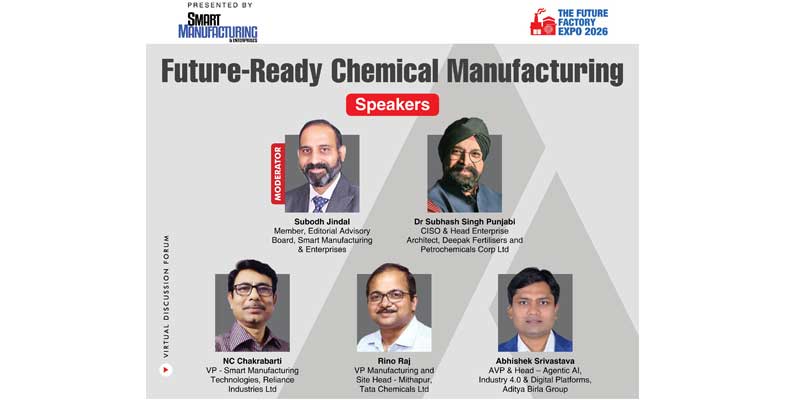
To discuss the role of automation, digital technologies and Industry 4.0 in shaping the future of chemical manufacturing, Smart Manufacturing & Enterprises (SM&E) magazine, in association with Future Factory Expo 2026 (FFE 2026), organised an online panel discussion titled “Future-Ready Chemical Manufacturing” on July 17, 2026, from 3.30 PM to 5.00 PM. The webinar was conducted under the “Future-Ready Factories Webinar Series” and brought together industry leaders to explore practical approaches for creating safer, smarter and more connected chemical manufacturing ecosystems.
The panel discussion was moderated by Subodh Jindal, Member, Editorial Advisory Board, SM&E, and featured insights from Rino Raj, Vice President Manufacturing and Site Head – Mithapur, Tata Chemicals Ltd; Dr Subhash Singh Punjabi, CISO & Head Enterprise Architect, Deepak Fertilisers and Petrochemicals Corp Ltd; NC Chakrabarti, Vice President – Smart Manufacturing Technologies, Reliance Industries Ltd; and Abhishek Srivastava, AVP & Head – Agentic AI, Industry 4.0 & Digital Platforms, Aditya Birla Group.
Opening the discussion, Subodh Jindal highlighted that the chemical industry is expected to play a crucial role in addressing future global requirements, particularly around energy transition and sustainability. However, he pointed out that while Industry 4.0 has been discussed for nearly a decade, adoption across industries has progressed slower than expected. The session focused on four critical areas — changing manufacturing landscapes, the role of automation in improving safety and efficiency, overcoming barriers such as legacy systems and skill gaps, and developing future-ready chemical factories.
Automation: From productivity tool to business enabler
Discussing how automation is helping chemical manufacturers balance productivity with safety, quality and compliance requirements, Rino Raj explained that automation has evolved significantly from its original purpose of replacing manual operations. Today, digital technologies, sensors and advanced control systems are enabling manufacturers to achieve multiple objectives simultaneously.
“Automation, to a large extent, started with the premise of replacing people with machines, thereby improving throughput. But today, we have reached a stage where automation has gone far beyond that with the help of digital and sensors,” said Raj. He added that modern automation systems are reducing the traditional trade-offs between safety, productivity and quality by enabling safer and more efficient operations.
Raj highlighted how technologies such as automated interlocks, continuous hazardous gas detection systems and automated trips are helping plants operate closer to their designed capabilities while improving safety. He also pointed out that automation is enabling better quality control through inline analysers, which allow manufacturers to monitor and correct process deviations in real time rather than depending on post-production inspection.
Automation is also simplifying compliance processes by enabling continuous data collection and automated reporting. According to Raj, connected sensors and automated historians are helping companies move from reactive compliance management towards a system where compliance becomes an inherent part of operations.
However, Raj also acknowledged that many chemical facilities still operate with a combination of old and new systems. “The future roadmap is exactly what you mentioned — connecting these islands so that they can start leveraging these parts,” he explained, adding that integrating different automation pockets across plants and geographies would become an important focus area going forward.
Modernising legacy plants through a phased approach
Addressing the challenge of upgrading existing chemical plants, Dr Subhash Singh Punjabi emphasised that digital transformation is no longer optional for manufacturers seeking long-term competitiveness. He noted that most chemical plants operate with legacy systems and therefore require a structured approach rather than complete replacement of existing infrastructure.
“It is a mandate to go ahead with the digital transformation, Industry 4.0 and connected shop floor. Otherwise, it can't be in the race,” said Dr Singh. He recommended a phased roadmap built around four stages — protect, connect, optimise and transform.
According to Dr Singh, replacing all existing systems through a “rip and replace” approach is expensive, disruptive and often impractical. Instead, companies should begin with a comprehensive assessment of existing operational technology (OT) assets, including DCS, PLC, SCADA and safety instrumented systems. This assessment should also consider asset criticality, cybersecurity risks, safety requirements, energy consumption and emission baselines.
He stressed the importance of creating a secure digital foundation before implementing advanced technologies. “Rather than replacing everything, use gateways and middleware. The objective is to make plant data accessible and actionable,” he explained. He also highlighted the importance of industrial data platforms, communication standards, connected historians and centralised dashboards to enable effective digital transformation.
Dr Singh concluded by emphasising the importance of five key elements — people, process, platform, protection and partnership — in successful transformation journeys. “Modernise progressively, not disruptively. Secure the plant first, create a connected digital foundation, then modernise and leverage data and AI,” he said.
Digital twins and AI accelerating sustainability goals
Discussing the role of automation, digital twins and real-time optimisation in achieving sustainability objectives, NC Chakrabarti stated that industries are increasingly recognising that sustainability and profitability can be achieved together through advanced technologies.
“Historically, sustainability was viewed as a compliance cost. But today, with advanced automation and digital twins, these are proving that carbon reduction and margin maximisation are actually two sides of the same coin,” said Chakrabarti.
He explained that digital twins in process industries are not limited to visual 3D representations but involve dynamic models running alongside live plant operations. These models can continuously analyse process conditions, optimise energy consumption and improve efficiency.
Chakrabarti highlighted thermodynamic digital twins as an example, where systems can analyse heat exchanger performance, optimise process routing and reduce dependence on external utilities, thereby lowering overall carbon footprint. He also explained how real-time optimisation systems are evolving by incorporating emission reduction objectives alongside productivity targets.
He further noted that advanced analytics and automation can help stabilise operations by reducing process disruptions and unnecessary energy consumption. “Efficiency is nothing but decarbonisation,” he added, highlighting the close connection between operational excellence and sustainability.
Preparing workforce for the digital factory
While technology remains central to Industry 4.0 transformation, Abhishek Srivastava emphasised that workforce readiness is equally important. He stated that successful digital transformation requires employees to be involved from the beginning rather than being trained only after technology deployment.
“Technology alone is not sufficient until the workforce is ready to embrace it,” said Srivastava. He explained that Aditya Birla Group follows a phased approach where employee engagement begins even before technology implementation through value discovery workshops.
Under the company’s 3S framework — Smart, Safe and Sustainable — employees participate in identifying operational challenges and suggesting areas where technology can create maximum value. Srivastava highlighted that involving employees in solution design improves acceptance and trust in new systems.
He added that organisations must continuously measure technology adoption, employee confidence and value creation after deployment. According to him, workforce transformation is not only about technical training but also about creating collaboration between people and technology.
Moving towards the future-ready chemical factory
The webinar highlighted that the future of chemical manufacturing will depend on integrating automation, digital platforms, AI, cybersecurity and skilled human resources. Rather than replacing existing systems completely, manufacturers must adopt progressive transformation strategies that create connected, intelligent and sustainable operations.
The Future-Ready Chemical Manufacturing webinar also served as a curtain-raiser to Future Factory Expo 2026 (FFE 2026), scheduled for November 3–4, 2026, at NESCO, Mumbai. FFE 2026 will bring together manufacturers, technology providers, policymakers and industry leaders through its exhibition, conference and Smart & Green Manufacturing Awards platform. By enabling meaningful interactions between technology solution providers and industrial adopters, the event will provide an important platform for companies looking to accelerate smart, sustainable and future-ready manufacturing practices in India.
Participation at FFE 2026 will offer chemical manufacturers an opportunity to explore emerging technologies, understand successful transformation approaches and build partnerships required to shape the factories of tomorrow.
Participate in FutureFactory Expo 2026 and
discover how AI can deliver a real manufacturing advantage.
Future Factory Expo 2026
Chemical manufacturing
Smart manufacturing
Industry 4.0
Industrial automation
Digital transformation
Artificial intelligence
Digital twins
Sustainable manufacturing
Process optimisation
Connected factories
Future-ready factories
Subodh Jindal
Rino Raj
Tata Chemicals
Dr Subhash Singh Punjabi
Deepak Fertilisers and Petrochemicals
NC Chakrabarti
Reliance Industries
Abhishek Srivastava
Aditya Birla Group
Agentic AI
Rakesh Rao
Related Stories
Automation & Robotics
Industrial AI is essential for autonomous plant operation: Swapnil Deosthali
In this interview with Rakesh Rao, Swapnil Deosthali, Executive VP and Head – Digital Industries, Siemens India, shares insights on building autonomous, sustainable and resilient manufacturing eco..
Read moreAutomation & Robotics
Future Factory Expo webinar reveals roadmap for future-ready chemical plants
The recently held Future Factory Expo (FFE) webinar explored how automation, AI and digital technologies can help chemical manufacturers build safer, smarter, sustainable and future-ready factories,..
Read moreAutomation & Robotics

Digitalisation is powering sustainable manufacturing: Bappa Bandyopadhyay
In this interaction with Rakesh Rao, Bappa Bandyopadhyay, Director Operations & Projects - India, Henkel Adhesive Technologies, shares insights on Henkel’s approach to digital transformation, smar..
Read moreRelated Products
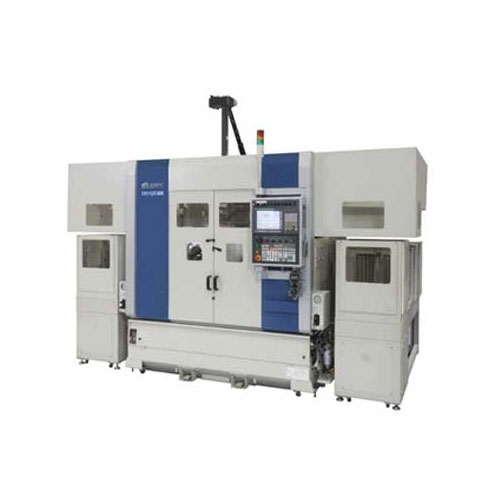
Compact Fmc - Motorum 3048tg With Fs2512
INDUSTRIAL AUTOMATION & TECHNOLOGY CONSULTANCY
Meiban Engineering Technologies Pvt Ltd offers a wide range of Compact FMC - Motorum 3048TG with FS2512.
Digital Colony Counter
INDUSTRIAL AUTOMATION & TECHNOLOGY CONSULTANCY
Rising Sun Enterprises supplies digital colony counter.

Robotic Welding SPM
INDUSTRIAL AUTOMATION & TECHNOLOGY CONSULTANCY
Primo Automation Systems Pvt. Ltd. manufactures, supplies and exports robotic welding SPM.
latest News
Subscribe to iNoW

For Industry News on WhatsApp, Give a Miss Call on: +91 84228 74016