








Schedule a Call Back


US Semiconductor Policy Shift Threatens Motion Control Market Momentum
 Articles
- Dec 05,25
Manufacturers now weigh financial incentives against political involvement, softening the long-term outlook for US semiconductor expansion.

The CHIPS
Act, launched in 2022 under the Biden administration, was designed to
accelerate reshoring by channelling $280 billion into domestic semiconductor
production. It marked a major effort to rebuild the United States’
manufacturing base and reduce reliance on overseas supply chains.
Under the
Trump administration, the policy shifted significantly. Intel was initially
promised CHIPS Act funding in March 2024 to expand domestic manufacturing
capacity. However, by August 2025, access to those funds became contingent on
the US government receiving a 10 per cent equity stake in the company. This
shift, positioning the federal government as a direct shareholder, represents a
significant departure from traditional subsidy-based industrial policy.
Manufacturers now weigh financial incentives against political involvement,
softening the long-term outlook for US semiconductor expansion.
Semiconductor
investment is a critical driver for industrial automation and motion control. Changes
to major subsidy programmes influence the timing, scale and certainty of
semiconductor equipment spending. Each new fabrication facility represents a
substantial investment in motion control systems, given the high level of
precision required. When fab projects slow or stall, motion control suppliers
feel the impact quickly. Prior to policy changes, US semiconductor and
electronics machinery revenue within the motion controls market was forecast to
grow strongly through 2029. Revised projections now indicate slower expansion
as uncertainty dampens investment.
Global policy and competition
International
strategies contrast sharply with the US approach.
The
European Chips Act, backed by €43 billion in public and private funding,
emphasises coordination over control. It supports cross-border R&D
initiatives and state-aid flexibility that allows member nations to fund
semiconductor fabs. Crucially, it does so without direct ownership or political
intervention. The result is a more predictable, collaborative environment that
has attracted significant foreign interest, including from US and Asian firms.
In Asia, Japan’s Chip Strategy and South Korea’s K-Chips Act follow similar
patterns.
Both
emphasise long-term stability, tax incentives and clear separation between
government support and corporate governance. When contrasted with these
partnership-driven models, the US approach appears increasingly interventionist.
The conversion of CHIPS funding into government equity has raised new questions
about the boundary between public subsidy and state control. For investors and
manufacturers evaluating long-term commitments, clarity and consistency are now
as important as the incentives.
Regional
investment choices for suppliers within the motion controls and automation
ecosystem are becoming increasingly important. Regions offering transparent,
partnership-based subsidy programmes are likely to capture a larger share of
motion control demand tied to semiconductor expansion. This is reflected in the
CAGR for countries with more transparent policies. South Korea, Taiwan and
Japan are expected to grow revenue at 2.5 per cent, 5.5 per cent and 5.0 per
cent respectively from 2023 to 2029.
Impact on motion controls
The motion controls market in the US is projected to see strong growth over the next decade, driven largely by semiconductor investment. In the US, the semiconductor and electronics sector revenue is expected to grow at a 6.3 per cent CAGR from 2023 to 2029, compared with 3.5 per cent overall market growth, making it the second-fastest-growing industry in the country. However, as federal policy in the US shifts, there is legitimate concern that the previously anticipated growth from the semiconductor sector could be undermined.

Source:
Interact Analysis
This growth
projection for the semiconductor & electronics machinery industry was prior
to the Intel announcement. It demonstrates how the United States semiconductor
market was on track to outpace overall Motion Control growth in the US.
What’s next?
If this
trend continues, its possible semiconductor manufacturers will prioritise
production expansion in other regions. Regions that successfully attract these
redirected investments from the United States could see a sharper uptick in
demand for motion controls over the next decade. Europe, Japan and South Korea
are emerging as preferred alternatives for semiconductor expansion, thanks to
transparent subsidy structures and predictable long-term policy. For the US,
the risk lies not in losing capacity, but in ceding momentum. If investors and
suppliers perceive the US market as unpredictable, they will redirect resources
to regions where industrial policy is stable and transparent. This could have
long-term implications for the global motion control landscape.
About
the author:
Clara Sipes
is a Market Analyst specializing in the Industrial Automation sector. With a
degree in International Business and a minor in Risk Management from the
McCombs School of Business at the University of Texas at Austin, Clara
leverages a strong academic background and analytical skills to drive insights
and strategies in the industry.
CHIPS Act
Semiconductor
Motion control
US policy
Europe
Asia
Manufacturing in US
automation
Equity stake
growth projections
US Chip Policy
Clara Sipes
Related Stories
Process Equipment

INOX India Q1 FY27 revenue rises 8.3% to ?3.82 bn
INOX India reported Q1 FY27 revenue of Rs 3.82 billion, with exports contributing 58 per cent, while its order book reached Rs 16.86 billion.
Read moreMachine Tools & Accessories

Walter to unveil new Helitronic and Helicheck at AMB and IMTS 2026
Walter will unveil new Helitronic and Helicheck machines at AMB and IMTS 2026, alongside solutions in grinding, measurement, EDM, software and automation.
Read moreSmart Manufacturing
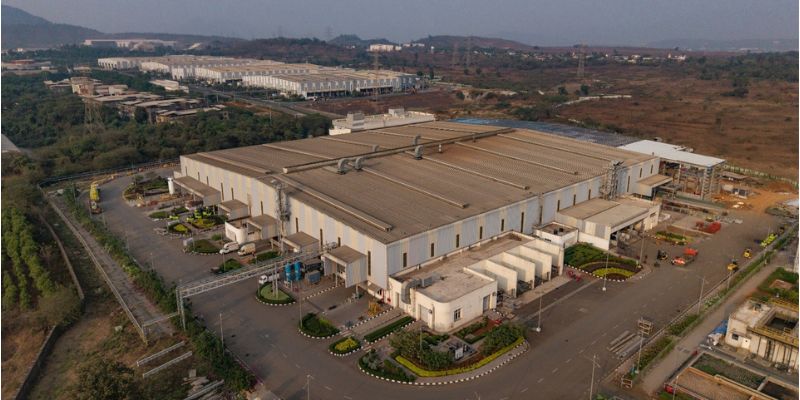
Godrej MHE begins operations at advanced Khalapur manufacturing facility
The facility will produce up to 6,000 material handling units annually, scalable to 15,000, for domestic and export markets.
Read moreRelated Products
Kusam-meco Handheld Thermal Camera Model- Km 300
ELECTRICAL & ELECTRONIC EQUIPMENT
KUSAM-MECO, the innovators of new products in the Test and Measurement field, have added a new Thermal Imager with Camera.
Read more
Ultra-slim Humidity/temperature Indicator With Large 4” Display
ELECTRICAL & ELECTRONIC EQUIPMENT
Countronics offers a wide range of ultra-slim humidity/temperature indicator with large 4” display – Model 7100-4W.
Read more
Integrated Electric Gripper S Series
ELECTRICAL & ELECTRONIC EQUIPMENT
IBK Engineers Pvt Ltd offers a wide range of integrated electric gripper S series.
latest News
Subscribe to iNoW

For Industry News on WhatsApp, Give a Miss Call on: +91 84228 74016