






Schedule a Call Back


India’s drone future needs scale, reliability, localisation: Vamsi Vikas Ganesula
 Interviews
- May 08,26
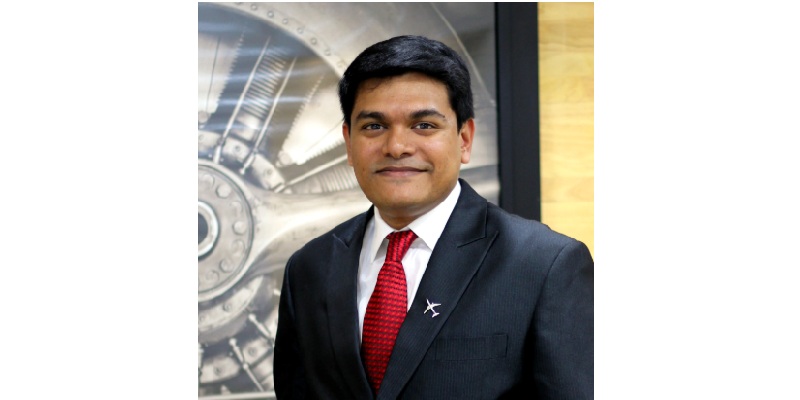
In this interview Vamsi Vikas Ganesula, Founder and Managing Director, Raghu Vamsi Aerospace Group outlines how conflicts, localisation, emerging technologies and policy support are reshaping India’s drone and counter-drone ecosystem.
How are ongoing conflicts in West Asia influencing the demand for drones and counter-drone systems globally and in India’s defence sector?
Current conflicts in areas such as Iran and West Asia have ensured that drones go from being auxiliary support tools to primary operational assets. The increased usage of drones has also seen an increased demand for measures that can be taken against such assets. In addition to this, the low costs associated with the operation of these devices allow for asymmetric warfare where a relatively weaker force can make a mark. As a result of all this, military and defence forces are increasingly relying on UAVs in order to perform surveillance, targeted attacks, and tactical movements. It is important for the systems to be capable of operating in contested areas without GPS, thereby ensuring seamless interoperability with C2 systems. In addition to this, they must also be able to survive and function despite being in an electronic warfare environment.
In India, the emerging trends indicate an increase in the need for rugged and deployable platforms. Furthermore, the protection of critical infrastructure ensures an increase in demand for counter-UAS measures.
Which government policies have been most relevant to the drone and defence ecosystem? How are these policies helping in driving local manufacturing, component-level indigenisation, defence integration, and skill development and what further measures are required?
The Drone Rules 2021, PLI scheme, and iDEX are among those initiatives which helped establish a foundation for the development of India’s drone industry.
Drone Rules have simplified regulations and made the entry barrier lower. Secondly, the PLI scheme provided an early push to local manufacturing capabilities. Thirdly, iDEX has been immensely useful in helping enable innovations and prototyping, especially those use cases where the lead is defence-oriented. Collectively, these three initiatives have enabled the ecosystem to take off.
However, what is needed now is not just innovation enablement but enabling scale. This will require increased alignment with defence procurement processes and greater visibility of programs. The transition from experimentation to induction needs to be very swift, to ensure that the prototypes are converted into operational drones.
In addition, it will become necessary to expedite the process of indigenous manufacture of parts, thus reducing the dependence on foreign subsystems. Simultaneously, investment in testbedding and validation infrastructure will prove crucial for building robust production systems.
In the end, success will come not through pilots, but via sustained program participation and large-scale deployments.
How far does India continue to rely on imports for critical drone components, and what strategies are companies adopting to accelerate localisation and self-reliance?
While India remains dependent on importing some critical drone parts, including sensors, electronics, and the propulsion sub-system, airframes and mechanical parts have been successfully localised. The process of localisation is being done in a step-by-step manner based on capability development. First, the emphasis was on developing systems integration capabilities, followed by indigenising critical sub-systems gradually. To make up for the current deficiencies, some strategic partnerships are being considered when required, but there is an emphasis on developing the capability in-house for those components that are strategically crucial in the long run.
It must be noted that localisation is a gradual process and needs continued investments towards testing and validation.
What are the principal roadblocks limiting the growth of India’s drone industry today, particularly in terms of access to technology, component supply chains and manufacturing scale-up? How is your organisation tackling these challenges?
The Indian drone industry still faces many challenges. One of the biggest challenges in this regard is that of the dependency on foreign supply for critical elements like electronics, propulsion, and secure communications. The second problem is that of the challenges that arise while making a transition from prototyping to production. While such solutions generally function effectively within a laboratory setting, implementing those solutions in the field itself can be a difficult process.
This challenge is also exacerbated by disjointed supply chain management and lack of access to military-grade testing facilities.
Moreover, there remain open issues with regard to process validation, configuration control, and quality control in mass production. At Raghu Vamsi Aerospace Group, we focus on having an aerospace-standard level of manufacturing knowledge. Our objective is to develop consistent systems with full lifecycle management and configuration control
What emerging technologies do you believe will shape the next generation of drones, and how are they influencing product design, operational efficiency and field deployment?
The next generation of drone technology will be defined by its integration and ability to provide mission-ready drones.
For example, edge AI-driven autonomous drones have emerged to enable decision-making in real-time with no reliance on connectivity – a vital requirement for denied and degraded operating environments. Meanwhile, sensor fusion is increasing situational awareness by processing various data streams in real-time.
Moreover, secure and encrypted communication systems are becoming increasingly essential, especially for defence purposes. The incorporation of GPS technology for navigation purposes has been complemented by other means, ensuring seamless operation even under hostile conditions for GPS technology.
From an engineering standpoint, the modular designs have made the system mission-dependent payloads flexible, whereas the interoperability principle makes it possible for the drone to function effectively on multiple platforms within the multidomain space.
Finally, there has been a shift in the focus from peak performance to operational reliability. The key criteria of new technologies include their readiness for deployment, where engineering takes precedence over innovation.
What new opportunities do you see emerging for Indian drone companies and how is your organisation preparing for these opportunities?
One of the areas in which Indian drone companies can take advantage of opportunities includes defence reconnaissance and logistics, especially when operating in difficult terrain that requires autonomous navigation. At the same time, there is a clear need for the rapid development of counter-drone technologies along with the steady progress of multi-platform and swarm strategies.
For dual-use opportunities, the industrial inspection segment and other hazardous environment operations present a viable avenue, with an increased appetite for not only advanced solutions but deployable and reliable ones. Reliability and lifecycle support have become crucial distinguishing factors in such cases.
The Raghu Vamsi Aerospace Group’s approach is program-focused as well, emphasising the build-up of program-level manufacturing and system integration capabilities. The Arrobot division of the company, focused on advanced technology, moves from the prototype phase to actual program-level execution.
India drone industry
defence drones
counter drone systems
UAV manufacturing
drone localisation
Drone Rules 2021
aerospace manufacturing
Raghu Vamsi Aerospace
Vamsi Vikas Ganesula
Related Stories
Aerospace Defence

Low-cost drones defeat costly military assets: Arth Chowdhary
In this interaction Arth Chowdhary, CEO, InsideFPV says, low-cost drone warfare in West Asia is driving urgent demand for domestic drones, counter-drone systems, localisation and next-generation def..
Read moreAerospace Defence
India’s drone future needs scale, reliability, localisation: Vamsi Vikas Ganesula
In this interview Vamsi Vikas Ganesula, Founder and Managing Director, Raghu Vamsi Aerospace Group outlines how conflicts, localisation, emerging technologies and policy support are reshaping Indiaâ..
Read moreAerospace Defence

India’s security calculus is shaped by West Asia conflict: Satyabrata Satapathy
In this interview with Satyabrata Satapathy, Co-founder & CEO BonV Aero, outlines how global conflicts, import dependence and policy shifts are accelerating India’s demand for drones, counter-dron..
Read moreRelated Products
Troop Comforts revolutionises military gear with indigenous innovations
Aerospace & Defence
Troop Comforts Ltd (TCL), a state-owned defence corporation, has recently received a request for proposal (RFP) from the Northern Command of the Indian Army for its indigenously developed military gea Read more
latest News
Subscribe to iNoW

For Industry News on WhatsApp, Give a Miss Call on: +91 84228 74016