







Schedule a Call Back


How India's Defence Sector Is Rewiring Industrial Capability
 Articles
- May 26,26
Domestic defence output reached Rs 1.54 trillion in FY2025, with exports surging 25-fold since 2017, signalling structural transformation and ecosystem growth, outlines Tushar Bhaskar, Chief Business Officer, Rubix Data Sciences.

The return of large-scale conflict, fractured trade routes, and the accelerating role of technology in warfare have pushed defence back to the centre of national planning worldwide. This time around, defence is not primarily about what a country can buy but about what a country can build, sustain, and sell.
A year after Operation Sindoor that distinction has sharpened in India. Output, supply chains, technology development, and export reach are now the metrics that matter. India's defence production reached a record Rs 1.54 trillion in FY2025, nearly 3.2 times higher than FY2015 levels, according to the latest Rubix Industry Insights: Defence report. Exports climbed from Rs 15 billion in FY2017 to Rs 384 billion in FY2026, a more than 25-fold increase in under a decade. The government has set targets of Rs 3 trillion in production and Rs 500 billion in exports by FY2029. These figures point to a sector that is structurally reorganising while also growing.
From import dependency to industrial depth
For most of India's post-independence history, defence modernisation meant procurement, mainly large acquisitions from Russia, France, Israel, and the United States, while domestic manufacturing remained largely confined to public sector undertakings. That architecture is changing.
In FY2025, the Ministry of Defence signed 193 contracts worth Rs 2.09 trillion. Of these, 92 per cent by volume and 81 per cent by value went to domestic firms. Roughly 65 per cent of India's defence equipment is now produced locally, inverting a sector that was 65 per cent–70 per cent import-dependent not long ago.
The shift is visible in specific programmes.
- Hindustan Aeronautics Limited secured Rs 620+ billion order for 97 Tejas Mk-1A fighter jets, alongside Rs 135+ billion order for 12 Sukhoi Su-30MKI aircraft.
- Bharat Dynamics Limited is expanding missile manufacturing through new assembly lines, rocket production facilities, and in-house energetics research.
- Bharat Electronics Limited has deepened indigenous radar, missile sighting, and communications manufacturing through procurement contracts and technology partnerships.
Meanwhile, private firms have moved well past subcontracting. Larsen & Toubro, Tata Advanced Systems, Bharat Forge, Adani Defence Systems and Technologies, and Paras Defence & Space Technologies now participate at the system level in artillery, naval platforms, armoured vehicles, precision-guided munitions, aerospace manufacturing, and unmanned technologies.
This matter beyond defence itself, unlike sectors where competitiveness rests on labour costs or scale alone, defence manufacturing demands process reliability, precision engineering, compliance infrastructure, and deep technological integration. Capabilities built to meet those requirements tend to migrate into adjacent sectors, including aerospace, electronics, automotive systems, robotics, advanced materials, and industrial automation. Indigenous defence production is, in this sense, an investment in manufacturing quality more broadly.
A more distributed industrial base
India's defence supply chain now reaches further down than it ever has. Approximately 16,000 MSMEs are active in defence manufacturing today, supplying precision components, electronics, subsystems, tooling, and software integration. Private firms accounted for 23 per cent of defence production in FY2025, up from 19 per cent in FY2017, and approximately 45 per cent of total defence exports in FY2026.
The scale of sustained procurement activity is reflected in order books. HAL's grew 3.5 times from Rs 529 billion in FY2020 to Rs 1,893 billion in FY2025. Bharat Dynamics Limited's tripled over the same period, from Rs 74 billion to Rs 228 billion. While they are company metrics, they also represent years of forward demand flowing through supplier networks at every tier.
This distributed structure changes the sector's risk profile in ways that have implications for anyone financing or supplying into it. Defence manufacturing operates on long procurement cycles and milestone-based execution. A stress event or compliance failure at a lower supplier tier can propagate upward through a programme. As domestic sourcing expands, supply chain monitoring and vendor resilience become operational concerns, not administrative ones.
Policy is moving from incentive to architecture
The current phase of policy is structurally different from what preceded it. Earlier reforms encouraged localisation; current instruments are attempting to build entire manufacturing ecosystems.
The Defence Acquisition Procedure (DAP) 2020 elevated the Indian-IDDM (Indigenously Designed, Developed and Manufactured) category. The draft DAP 2026 proposes raising indigenous content requirements from 50 per cent to 60 per cent under Buy Indian-IDDM. The Defence Procurement Manual 2025 aims to streamline procedures and support indigenous sourcing.
The Positive Indigenisation List (PIL) is emerging as one of the more consequential instruments. The fifth PIL, released in 2024, covered 346 strategically important items, such as systems, components, raw materials, and subsystems, mandated for domestic sourcing within defined timelines. More than 36,000 items had been offered for indigenisation by June 2024, with over 12,300 already indigenised since 2021. Indigenisation at this scale is not import substitution by count. It requires creating domestic suppliers capable of consistently meeting reliability, testing, and certification requirements.
Dedicated Defence Industrial Corridors in Uttar Pradesh and Tamil Nadu are concentrating manufacturing capabilities geographically. By October 2025, they had attracted investments exceeding Rs 91.4 billion and facilitated 289 Memoranda of Understanding.
Then there is drone manufacturing, which is receiving dedicated attention. PLI initiatives for unmanned systems are supporting domestic production of drones, counter-drone technologies, software, and components. The target of localising at least 40 per cent of critical drone parts by FY2028 reflects the scale of strategic interest in this segment.
Together, these mechanisms are attempting to make localisation commercially self-sustaining rather than permanently policy-dependent.
Exports reshaping economics
India's defence exports have historically been limited and episodic. That has changed. Exports reached Rs 384 billion in FY2026, a 63 per cent increase over the prior year, spanning more than 80 countries. The number of Indian defence exporters rose from 128 in FY2025 to 145 in FY2026, indicating that export participation is broadening beyond a handful of large firms. The product mix now includes BrahMos cruise missiles, Akash air-defence systems, artillery, radars, armoured systems, naval platforms, surveillance equipment, and aerospace components.
The significance of exports is not primarily the foreign revenue. It is that export demand has restructured the economics of domestic manufacturing. When India's defence industry depended almost entirely on domestic government orders, production was cyclical and procurement-driven. Export contracts diversify demand, extend production runs, improve utilisation rates, and justify investment in process and technology capability that domestic orders alone would not support.
The composition of exports illustrates how the mix is maturing. Naval vessels accounted for roughly 55 per cent of exports between 2016 and 2025. Naval export value under HS code 89069090 grew from negligible levels in FY2018 to approximately Rs 66.9 billion by FY2026 (April to January). Missile and air-defence munitions exports grew at approximately 65 per cent CAGR over the same period. This means, India's export story is moving towards higher-value platforms and away from component supply.
Export credibility also signals manufacturing credibility. Defence buyers assess suppliers on reliability, technology capability, lifecycle support, and maintenance infrastructure, besides cost. An expanding export footprint is evidence that more buyers are satisfied on those dimensions.
The technology layer
Alongside industrial scaling, a start-up driven technology layer has taken shape. India had over 1,000 defence start-ups as of September 2024. Aerospace, maritime, and defence technology start-ups collectively attracted nearly $ 2 billion in funding between 2017 and 2025, with $ 548 million rose in 2025 alone. Tellingly, while the number of newly founded start-ups peaked in 2022 and has since declined, total funding has continued to rise, a pattern that marks a maturing ecosystem rather than simply a growing one, with capital concentrating in fewer, higher-potential companies rather than being spread across new entrants.
Modern warfare's increasing dependence on drones, autonomous systems, AI-enabled targeting, electronic warfare, and cybersecurity creates a demand that traditional defence manufacturing cannot meet at the pace required. Start-ups are filling that gap; the iDEX programme has accelerated this by directly connecting military requirements with private innovation, a model that reflects how defence technology ecosystems globally are increasingly shaped by agile development networks rather than large conglomerates alone.
Remaining challenges
Despite the momentum in domestic manufacturing, India remains the world's second-largest arms importer, accounting for 8.2 per cent of global imports between 2021 and 2025. Russia's share of India's imports fell from approximately 70 per cent during 2011–2015 to around 40 per cent during 2021–2025, as France and Israel expanded their positions. The diversification is real, but the dependence is not gone.
The gaps that remain are structural, not incidental. India still relies on imports for jet engines, advanced sensors, semiconductors, and sophisticated propulsion systems. For instance, India's indigenous Kaveri engine programme, intended to power the Tejas fighter, failed to meet required thrust levels even after decades of development, leaving the aircraft dependent on foreign propulsion. Negotiations for 114 Dassault Rafale jets have stalled over weapon integration rights and access to sensitive aircraft systems. A batch of Boeing AH-64 Apache helicopters arrived roughly 15 months late due to global supply chain disruptions. Each case illustrates a different dimension of the same vulnerability, where technology transfer restrictions, export control regimes, and geopolitical friction can interrupt, delay, or condition access to critical inputs.
Closing these gaps requires a different order of effort from scaling assembly or platform manufacturing. It demands sustained R&D investment, genuine industry-academia integration, long-term capital commitment, and tolerance for slow timelines. As Defence Minister, Rajnath Singh put it recently, "We must design, develop, produce, maintain, and upgrade key systems within our own national ecosystem. That is how we will secure our strategic autonomy."
The next phase of India's defence journey will be defined less by what it procures than by how much ground it closes on the hard technologies it still cannot build at home.
Wider implications
India's defence sector is now relevant to a wider set of participants including manufacturers, lenders, exporters, supply chain operators, and technology investors, more so than at any previous point. The order books of major defence companies reflect this, creating sustained demand across supplier networks with the kind of multi-year visibility that allows confident investment in capacity, technology, and talent.
However, the same complexity that creates opportunity also creates exposure. Financial stress, operational delays, or compliance failures within one layer of the ecosystem can cascade across programmes. As domestic sourcing deepens, the resilience of the industrial base and the resilience of national defence capability become increasingly the same question.
India is building a defence manufacturing ecosystem that includes public enterprises, private manufacturers, MSMEs, start-ups, research institutions, and specialised supplier networks. What it builds over the next decade will not just determine its military capability; it will also shape its position in global manufacturing, advanced engineering, and strategic supply chains well beyond defence itself.
About the author
Tushar Bhaskar is Chief Business Officer at Rubix. He is responsible for growing the company’s revenues across multiple channels. With 17 years of experience in Information Services, Risk Assessment, and Analytics, he has held leadership roles at Ernst & Young (EY), Equifax India, and Dun & Bradstreet India, where he headed sales across the Credit, Compliance, and Supply Chain business verticals.
India defence production
defence exports
indigenous manufacturing
defence start-ups
HAL Tejas
defence supply chain
iDEX programme
PLI drones
Tushar Bhaskar
Rubix Data Sciences
Related Stories
Machine Tools & Accessories
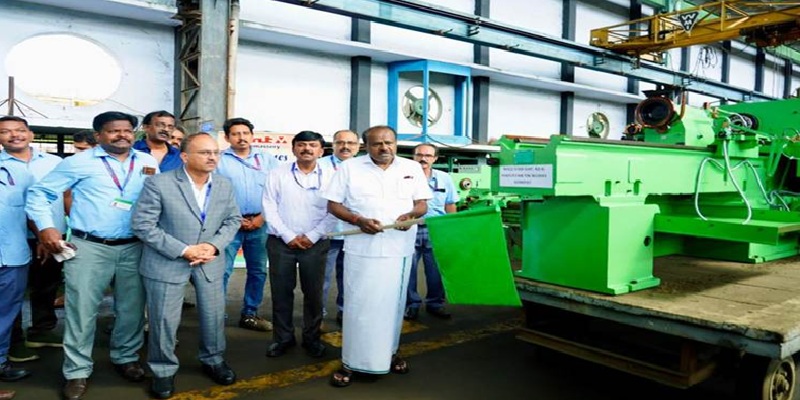
HMT Exports Indigenous Machine Tool to South Africa
Union Minister H.D. Kumaraswamy reviews HMT Kalamassery’s manufacturing capabilities, export growth, modernisation plans and PSU strengthening efforts.
Read moreAerospace Defence
How India's Defence Sector Is Rewiring Industrial Capability
Domestic defence output reached Rs 1.54 trillion in FY2025, with exports surging 25-fold since 2017, signalling structural transformation and ecosystem growth, outlines Tushar Bhaskar, Chief Busines..
Read morePolicy Regulation

West Asia conflict: Indian manufacturing sector navigating a systemic shock
The West Asia conflict has exposed deep structural vulnerabilities in India’s manufacturing ecosystem—spanning energy dependence, supply chains, and export markets—while intensifying pressure ..
Read moreRelated Products
Troop Comforts revolutionises military gear with indigenous innovations
Aerospace & Defence
Troop Comforts Ltd (TCL), a state-owned defence corporation, has recently received a request for proposal (RFP) from the Northern Command of the Indian Army for its indigenously developed military gea Read more
latest News
Subscribe to iNoW

For Industry News on WhatsApp, Give a Miss Call on: +91 84228 74016