





Schedule a Call Back


Future Factory Expo webinar explores real-world AI use in factories
 Articles
- Jun 29,26
Future Factory Expo (FFE) recently hosted a webinar bringing together senior leaders from manufacturing, digital transformation and workforce development to decode artificial intelligence's role on the factory floor.
Artificial intelligence (AI) is no longer just a boardroom conversation for manufacturers. It is entering factories, production lines, quality systems and supply chains, forcing Indian industry to ask a sharper question: is AI delivering measurable impact, or is it still being oversold as a futuristic promise?
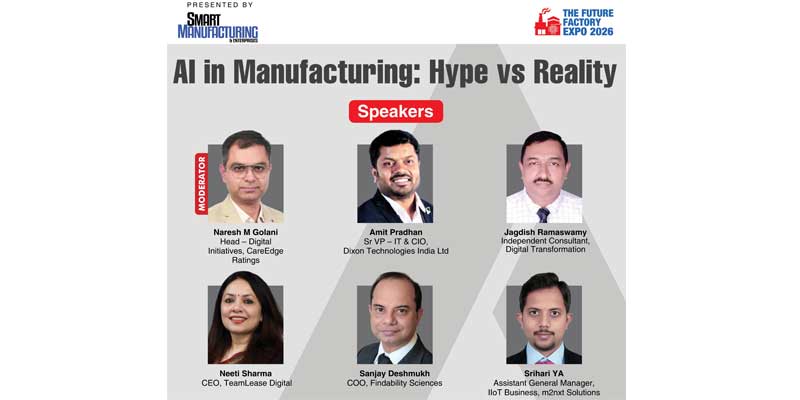
This was the central theme of the online panel discussion titled “AI in Manufacturing: Hype vs Reality”, organised by Smart Manufacturing & Enterprises (SM&E) magazine in association with Future Factory Expo 2026 on June 26, 2026. The webinar served as a curtain-raiser to Future Factory Expo 2026, scheduled for November 3–4 at NESCO, Mumbai.
Moderated by Naresh Golani, Head – Digital Initiatives, CareEdge Ratings, the discussion brought together senior leaders from manufacturing, digital transformation, workforce development, industrial IoT and AI solutions. The panel featured Amit Pradhan, Sr VP – IT & CIO, Dixon Technologies India Ltd; Jagdish Ramaswamy, Independent Consultant, Digital Transformation; Neeti Sharma, CEO, TeamLease Digital; Sanjay Deshmukh, COO, Findability Sciences; and Srihari YA, Assistant GM - IIoT Business, m2nxt Solutions (a BFW subsidiary).
Opening the discussion, Golani framed the session around two key questions: how AI is creating real business impact today, and how organisations can scale it sustainably. “The focus is on moving AI from hype to real business impact,” he said, setting the tone for a practical conversation around return on investment, pilot failures, data readiness, workforce transformation and the foundations of an AI-ready factory.
Tangible benefits of AI
For Indian manufacturing, the timing of the discussion was significant. AI is being positioned as a game-changer for productivity, quality, energy efficiency, resilience and planning. However, many manufacturers continue to face familiar roadblocks, including fragmented data, lack of system integration, limited digital skills and difficulty in moving beyond proof-of-concept projects. The webinar examined where AI is already delivering tangible gains, including reduced downtime, better defect detection, lower energy consumption, improved planning efficiency and more informed decision-making.
By placing AI in the larger context of manufacturing transformation over the past three decades, Amit Pradhan noted, “The 1990s was shaped by enterprise resource planning (ERP) and system integration, the 2000s by lean manufacturing and process improvements, and the 2010s by automation, Industry 4.0 and connected operations. AI represents the next major disruption.”
According to him, the real promise of AI is enabling organisations to make better decisions faster and at scale. Pradhan pointed out that manufacturers that successfully scale AI can unlock productivity gains, improve quality, strengthen material traceability and reduce operational losses. However, he also cautioned that scaling remains a challenge.
According to Pradhan, this is not because the algorithms are weak. The bigger issue is operationalisation. Many companies run disconnected pilots without linking them to enterprise-wide value pools. For AI to succeed, it must be connected to real manufacturing priorities. He highlighted use cases across operational resilience, quality, supply chain planning and workforce augmentation. In quality, AI-powered computer vision can detect defects that may not be visible to the human eye. In supply chain, AI can support alternate part planning, material planning, capacity planning and resource optimisation.
Taking the discussion forward, Sanjay Deshmukh focused on where AI is delivering the fastest and most tangible return on investment in Indian manufacturing. “The biggest gains come when manufacturers look at AI from an end-to-end business value chain perspective,” Deshmukh said. While predictive maintenance is useful, he said companies should also focus on demand forecasting, production planning, quality analytics, process optimisation and yield improvement.
Demand forecasting, in particular, is a critical use case for manufacturers, including small and medium enterprises (SMEs). Poor forecasting can lead to overstocking, higher inventory costs and blocked working capital, or understocking, which results in missed sales. Deshmukh pointed out that many companies still depend on ERP-based forecasting, Excel sheets or human judgement. These methods often struggle when companies handle a large number of SKUs with different demand patterns.
AI can improve forecast accuracy by analysing internal data along with external variables such as seasonality, weather, commodity prices and market trends. Better forecasting can reduce inventory, improve working capital efficiency and strengthen turnover ratios. Deshmukh also emphasised the importance of unified data visibility. In many factories, valuable data is locked inside SCADA systems, programmable logic controllers and ERP platforms. Unless this data is brought together, manufacturers cannot identify hidden losses such as stoppages, wastage or small process drifts.
He also highlighted the value of quality analytics and yield optimisation. Even a small improvement in yield can produce significant financial benefits in process industries such as sugar, dairy, beverages, chemicals and pharmaceuticals. “The purpose of AI is to augment the business decisions manufacturers make every day,” Deshmukh said.
From pilot to scale
The discussion then turned to why many AI pilots fail to scale. Jagdish Ramaswamy offered a candid assessment based on his experience leading large transformation programmes. Instead of only asking why AI projects fail, he suggested that companies should look at what successful implementations do differently.
“AI sits on top of basic discipline of process and data,” Ramaswamy said. He listed five critical requirements for AI success: a clearly defined business problem, stable processes, reliable data, business ownership and cultural adoption. According to him, one of the common mistakes companies make is using AI because it is exciting, rather than because it solves a problem that matters to the business.
For manufacturing leaders, the right AI use cases should be tied to metrics such as overall equipment effectiveness (OEE), productivity, cost of goods sold, profitability, inventory reduction, waste minimisation and sustainability. If a problem is actually caused by poor shopfloor discipline or weak processes, AI alone cannot solve it.
Ramaswamy also stressed that AI initiatives should not be owned only by IT teams or data scientists. The ownership must sit with the plant, process engineers, supervisors and operators who are directly affected by the problem being solved. He warned that if IT teams try to prove technology capability without involving the shopfloor, the project is unlikely to scale. Operators and middle managers must be included from the beginning because they understand the process realities and data quality issues better than anyone else.
Building on the data foundation theme, Srihari explained the role of industrial IoT, connected machines and edge data collection in creating an AI-ready factory. He described industrial IoT not as a supporting technology, but as the foundation on which manufacturing AI depends.
“Industrial IoT, connected machines and edge data collection are the foundation of the entire AI-ready factory,” Srihari said. Without reliable, real-time operational data, AI models cannot scale beyond pilot stages. He said manufacturers need to move beyond manual data collection and spreadsheet-based reporting, which can be inconsistent and inaccurate.
Srihari described AI as the tip of a pyramid. At the base are shopfloor machines and operational technology assets. These may include both modern machines and equipment that is decades old. The first step is to capture realistic, real-time data from these machines, whether through advanced communication protocols in newer equipment or limited data extraction from older assets.
The next layer is real-time visibility of assets, followed by contextualisation through systems such as manufacturing execution systems (MES) and enterprise resource planning (ERP) platforms. Only after these layers are in place can AI and advanced analytics deliver reliable results. He added that edge computing is becoming increasingly important because critical decisions on production lines require high-speed, low-latency responses.
For manufacturers beginning their AI journey, Srihari recommended starting with digital visibility and creating a single source of truth from machine data. Once data quality improves, companies can identify high-return, low-risk use cases that build trust in AI before scaling to more complex applications.
Why human intelligence matters
The people dimension of AI adoption was addressed by Neeti Sharma, who argued that workforce transformation will be central to the future of AI-enabled manufacturing. As AI moves from experimentation to operations, the skills required in factories are changing.
“The biggest change will not be people getting replaced with AI, but AI changing the kind of people companies hire,” Sharma said. Traditionally, manufacturing hiring has focused heavily on operational skills. In the coming years, companies will need people who can work alongside AI, use data to make decisions and improve processes.
According to Sharma, the future manufacturing workforce will require a combination of engineering, operations and technology skills. Routine tasks in quality checks, monitoring, reporting, scheduling, logistics and supply chain operations are increasingly being automated. At the same time, new roles are emerging in robotics, predictive maintenance, industrial data analytics, digital twins, physical AI, AI-enabled production engineering and cybersecurity.
Sharma also cautioned manufacturers against adopting AI merely because of fear of being left behind. In some cases, the cost of AI deployment may be higher than the cost of human deployment. Therefore, the balance between human capability and AI investment must be carefully evaluated. “AI has to be utilised in the right fashion, in the right place,” she said.
The panel discussion made it clear that AI cannot be treated as a standalone technology layer. It must be supported by disciplined processes, connected machines, contextualised data, clear ownership and leadership commitment. For Indian manufacturing, the opportunity is significant, but the path to scale requires patience, structure and execution. For companies willing to align business goals, technology foundations and people capabilities, AI can become more than a buzzword. It can become a scalable manufacturing advantage.
Artificial intelligence (AI) is no longer just a boardroom conversation for manufacturers. It is entering factories, production lines, quality systems and supply chains, forcing Indian industry to ask a sharper question: is AI delivering measurable impact, or is it still being oversold as a futuristic promise?
This was the central theme of the online panel discussion titled “AI in Manufacturing: Hype vs Reality”, organised by Smart Manufacturing & Enterprises (SM&E) magazine in association with Future Factory Expo 2026 on June 26, 2026. The webinar served as a curtain-raiser to Future Factory Expo 2026, scheduled for November 3–4 at NESCO, Mumbai.
Moderated by Naresh Golani, Head – Digital Initiatives, CareEdge Ratings, the discussion brought together senior leaders from manufacturing, digital transformation, workforce development, industrial IoT and AI solutions. The panel featured Amit Pradhan, Sr VP – IT & CIO, Dixon Technologies India Ltd; Jagdish Ramaswamy, Independent Consultant, Digital Transformation; Neeti Sharma, CEO, TeamLease Digital; Sanjay Deshmukh, COO, Findability Sciences; and Srihari YA, Assistant GM - IIoT Business, m2nxt Solutions (a BFW subsidiary).
Opening the discussion, Golani framed the session around two key questions: how AI is creating real business impact today, and how organisations can scale it sustainably. “The focus is on moving AI from hype to real business impact,” he said, setting the tone for a practical conversation around return on investment, pilot failures, data readiness, workforce transformation and the foundations of an AI-ready factory.
Tangible benefits of AI
For Indian manufacturing, the timing of the discussion was significant. AI is being positioned as a game-changer for productivity, quality, energy efficiency, resilience and planning. However, many manufacturers continue to face familiar roadblocks, including fragmented data, lack of system integration, limited digital skills and difficulty in moving beyond proof-of-concept projects. The webinar examined where AI is already delivering tangible gains, including reduced downtime, better defect detection, lower energy consumption, improved planning efficiency and more informed decision-making.
By placing AI in the larger context of manufacturing transformation over the past three decades, Amit Pradhan noted, “The 1990s was shaped by enterprise resource planning (ERP) and system integration, the 2000s by lean manufacturing and process improvements, and the 2010s by automation, Industry 4.0 and connected operations. AI represents the next major disruption.”
According to him, the real promise of AI is enabling organisations to make better decisions faster and at scale. Pradhan pointed out that manufacturers that successfully scale AI can unlock productivity gains, improve quality, strengthen material traceability and reduce operational losses. However, he also cautioned that scaling remains a challenge.
According to Pradhan, this is not because the algorithms are weak. The bigger issue is operationalisation. Many companies run disconnected pilots without linking them to enterprise-wide value pools. For AI to succeed, it must be connected to real manufacturing priorities. He highlighted use cases across operational resilience, quality, supply chain planning and workforce augmentation. In quality, AI-powered computer vision can detect defects that may not be visible to the human eye. In supply chain, AI can support alternate part planning, material planning, capacity planning and resource optimisation.
Taking the discussion forward, Sanjay Deshmukh focused on where AI is delivering the fastest and most tangible return on investment in Indian manufacturing. “The biggest gains come when manufacturers look at AI from an end-to-end business value chain perspective,” Deshmukh said. While predictive maintenance is useful, he said companies should also focus on demand forecasting, production planning, quality analytics, process optimisation and yield improvement.
Demand forecasting, in particular, is a critical use case for manufacturers, including small and medium enterprises (SMEs). Poor forecasting can lead to overstocking, higher inventory costs and blocked working capital, or understocking, which results in missed sales. Deshmukh pointed out that many companies still depend on ERP-based forecasting, Excel sheets or human judgement. These methods often struggle when companies handle a large number of SKUs with different demand patterns.
AI can improve forecast accuracy by analysing internal data along with external variables such as seasonality, weather, commodity prices and market trends. Better forecasting can reduce inventory, improve working capital efficiency and strengthen turnover ratios. Deshmukh also emphasised the importance of unified data visibility. In many factories, valuable data is locked inside SCADA systems, programmable logic controllers and ERP platforms. Unless this data is brought together, manufacturers cannot identify hidden losses such as stoppages, wastage or small process drifts.
He also highlighted the value of quality analytics and yield optimisation. Even a small improvement in yield can produce significant financial benefits in process industries such as sugar, dairy, beverages, chemicals and pharmaceuticals. “The purpose of AI is to augment the business decisions manufacturers make every day,” Deshmukh said.
From pilot to scale
The discussion then turned to why many AI pilots fail to scale. Jagdish Ramaswamy offered a candid assessment based on his experience leading large transformation programmes. Instead of only asking why AI projects fail, he suggested that companies should look at what successful implementations do differently.
“AI sits on top of basic discipline of process and data,” Ramaswamy said. He listed five critical requirements for AI success: a clearly defined business problem, stable processes, reliable data, business ownership and cultural adoption. According to him, one of the common mistakes companies make is using AI because it is exciting, rather than because it solves a problem that matters to the business.
For manufacturing leaders, the right AI use cases should be tied to metrics such as overall equipment effectiveness (OEE), productivity, cost of goods sold, profitability, inventory reduction, waste minimisation and sustainability. If a problem is actually caused by poor shopfloor discipline or weak processes, AI alone cannot solve it.
Ramaswamy also stressed that AI initiatives should not be owned only by IT teams or data scientists. The ownership must sit with the plant, process engineers, supervisors and operators who are directly affected by the problem being solved. He warned that if IT teams try to prove technology capability without involving the shopfloor, the project is unlikely to scale. Operators and middle managers must be included from the beginning because they understand the process realities and data quality issues better than anyone else.
Building on the data foundation theme, Srihari explained the role of industrial IoT, connected machines and edge data collection in creating an AI-ready factory. He described industrial IoT not as a supporting technology, but as the foundation on which manufacturing AI depends.
“Industrial IoT, connected machines and edge data collection are the foundation of the entire AI-ready factory,” Srihari said. Without reliable, real-time operational data, AI models cannot scale beyond pilot stages. He said manufacturers need to move beyond manual data collection and spreadsheet-based reporting, which can be inconsistent and inaccurate.
Srihari described AI as the tip of a pyramid. At the base are shopfloor machines and operational technology assets. These may include both modern machines and equipment that is decades old. The first step is to capture realistic, real-time data from these machines, whether through advanced communication protocols in newer equipment or limited data extraction from older assets.
The next layer is real-time visibility of assets, followed by contextualisation through systems such as manufacturing execution systems (MES) and enterprise resource planning (ERP) platforms. Only after these layers are in place can AI and advanced analytics deliver reliable results. He added that edge computing is becoming increasingly important because critical decisions on production lines require high-speed, low-latency responses.
For manufacturers beginning their AI journey, Srihari recommended starting with digital visibility and creating a single source of truth from machine data. Once data quality improves, companies can identify high-return, low-risk use cases that build trust in AI before scaling to more complex applications.
Why human intelligence matters
The people dimension of AI adoption was addressed by Neeti Sharma, who argued that workforce transformation will be central to the future of AI-enabled manufacturing. As AI moves from experimentation to operations, the skills required in factories are changing.
“The biggest change will not be people getting replaced with AI, but AI changing the kind of people companies hire,” Sharma said. Traditionally, manufacturing hiring has focused heavily on operational skills. In the coming years, companies will need people who can work alongside AI, use data to make decisions and improve processes.
According to Sharma, the future manufacturing workforce will require a combination of engineering, operations and technology skills. Routine tasks in quality checks, monitoring, reporting, scheduling, logistics and supply chain operations are increasingly being automated. At the same time, new roles are emerging in robotics, predictive maintenance, industrial data analytics, digital twins, physical AI, AI-enabled production engineering and cybersecurity.
Sharma also cautioned manufacturers against adopting AI merely because of fear of being left behind. In some cases, the cost of AI deployment may be higher than the cost of human deployment. Therefore, the balance between human capability and AI investment must be carefully evaluated. “AI has to be utilised in the right fashion, in the right place,” she said.
The panel discussion made it clear that AI cannot be treated as a standalone technology layer. It must be supported by disciplined processes, connected machines, contextualised data, clear ownership and leadership commitment. For Indian manufacturing, the opportunity is significant, but the path to scale requires patience, structure and execution. For companies willing to align business goals, technology foundations and people capabilities, AI can become more than a buzzword. It can become a scalable manufacturing advantage.
Participate in Future Factory Expo 2026 and discover how AI can deliver a real manufacturing advantage.
Future Factory Expo
Smart Manufacturing & Enterprises
AI in Manufacturing
Future Factory Expo webinar
Future Factory Expo 2026
Naresh Golani
CareEdge Ratings
industrial IoT
AI solutions
Amit Pradhan
Dixon Technologies
Jagdish Ramaswamy
Neeti Sharma
TeamLease Digital
Sanjay Deshmukh
Findability Sciences
Srihari YA
m2nxt Solutions
BFW
why AI pilots fail to scale
Industrial Automation
Related Stories
Automation & Robotics
Future Factory Expo CXO Roundtable Charts Smart Transformation for SMEs
During the roundtable, hosted by Smart Manufacturing & Enterprises (SM&E) and The Future Factory Expo 2026, industry leaders outlined how SMEs can use practical digitisation, automation, skilling an..
Read moreAutomation & Robotics
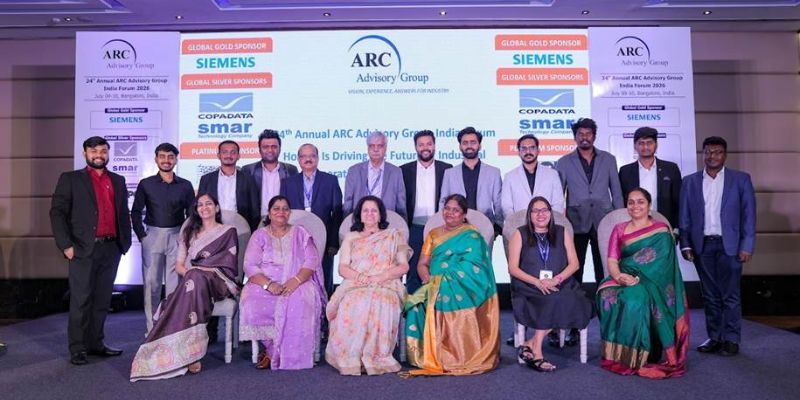
ARC India Forum Spotlights AI-Led Industrial Transformation
ARC Advisory Group’s 24th India Forum brought together 300-plus leaders to examine how AI is transforming industrial operations, manufacturing and supply chains.
Read moreSmart Manufacturing

Hitachi Vantara’s Norman Plant Named WEF Lighthouse Facility
Hitachi Vantara’s Norman manufacturing site has earned WEF Lighthouse status for using AI to reduce lead times, inventory and carbon emissions.
Read moreRelated Products
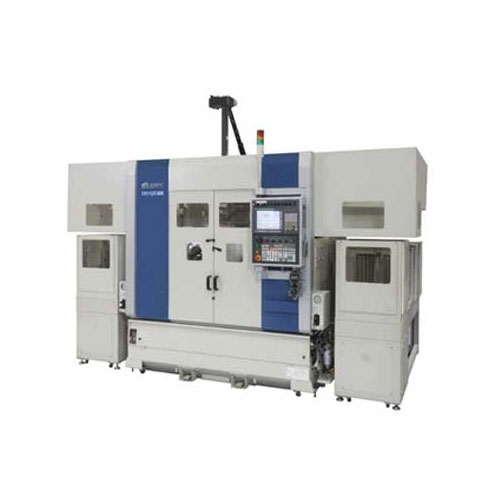
Compact Fmc - Motorum 3048tg With Fs2512
INDUSTRIAL AUTOMATION & TECHNOLOGY CONSULTANCY
Meiban Engineering Technologies Pvt Ltd offers a wide range of Compact FMC - Motorum 3048TG with FS2512.

Digital Colony Counter
INDUSTRIAL AUTOMATION & TECHNOLOGY CONSULTANCY
Rising Sun Enterprises supplies digital colony counter.

Robotic Welding SPM
INDUSTRIAL AUTOMATION & TECHNOLOGY CONSULTANCY
Primo Automation Systems Pvt. Ltd. manufactures, supplies and exports robotic welding SPM.
latest News
Subscribe to iNoW

For Industry News on WhatsApp, Give a Miss Call on: +91 84228 74016