





Schedule a Call Back


SME Smart Manufacturing Conference: Engineering Resilience. Rewarding Growth
 Articles
- Feb 24,26
With India aiming to be the center of global manufacturing activity, Smart Manufacturing & Enterprises (SME) Conference & Awards 2026 highlighted importance of resilience and disciplined approach to achieve robust growth, while honouring engineering firms that performed remarkably in volatile times.

Highlights of SME Conference & Awards 2026
- Over 25 industry leaders deliberated on the future roadmap for India’s manufacturing sector amid a volatile global environment, under the theme ‘Scaling India’s Manufacturing in Volatile Times’.
- The SME Awards honoured India’s Fastest Growing Engineering Companies through a transparent, data-driven evaluation based on revenue and net profit performance over the past three financial years.
- Companies were recognised across four revenue categories—Small, Medium, Large and Very Large—collectively forming the ‘Top 100 Engineering Companies in India’.
- Ashish Chauhan, MD & CEO, National Stock Exchange of India, attended as Guest of Honour, alongside policymakers, manufacturing leaders, technology providers and financial institutions.
- Leaders from Wipro, Mitsubishi Electric, Aditya Birla Group, Legrand, NRB Bearings, RXIL, Godrej Enterprises Group, Walvoil Fluid Power, Amazon Web Services, PwC India, TeamLease Digital, Bharat Bijlee, Cyient DLM, Greaves Cotton, Rubix Data Sciences, EY India and CareEdge Ratings shared industry insights.
- Panel discussions addressed manufacturing resilience amid geopolitical volatility, AI-driven automation and digital transformation, and strategies for SME scale-up and global integration.
- The event also witnessed the unveiling of the 54th Annual Edition of Smart Manufacturing & Enterprises, reinforcing its longstanding role as a knowledge platform for India’s engineering ecosystem.
On February 11, 2026, Smart Manufacturing & Enterprises Conference & Awards 2026 – organised by Smart Manufacturing & Enterprises (SME) at the National Stock Exchange of India (NSE), Mumbai - brought together policymakers, manufacturing leaders, technology providers and financial institutions to deliberate on the theme ‘Scaling India’s Manufacturing in Volatile Times’. The conference concluded with the presentation of the SME Awards for Fastest Growing Engineering Companies, recognising enterprises that demonstrated sustained revenue growth and profitability despite global uncertainties.
Smart Manufacturing & Enterprises (formerly Industrial Products Finder), with its 54-year legacy in industrial journalism, positioned the conference as a strategic forum to examine resilience, technology maturity and disciplined scale within India’s engineering ecosystem.
India’s manufacturing sector enters 2026 at a decisive inflection point. While policy-led momentum, rising capital formation and accelerated digital adoption have strengthened confidence in Indian engineering capabilities, global trade fragmentation, supply-chain realignments and volatility continue to test resilience. The conference focused on embedding stability, innovation and technology maturity into the next phase of industrial growth.
SME Conference & Awards was supported by National Stock Exchange (as the Venue Partner) and SME Chamber of India (Association Partner). The event was organised as a precursor to The Future Factory Expo 2026, which will be hosted Smart Manufacturing & Enterprises on November 3-4, 2026 at NESCO (Mumbai), to bring together solution providers for high-tech manufacturing, which will be crucial for driving India's economic growth.
Inaugural sessions
Setting the tone for the day, Pratap Padode, Founder & Managing Director, ASAPP Info Global Group and Editor-in-Chief, Smart Manufacturing & Enterprises, emphasised the need for structural consolidation in Indian manufacturing. He stated that “India’s manufacturing ecosystem stands at a decisive inflection point. Building on a 54-year legacy of Industrial Products Finder—once regarded as the ‘Bible’ of India’s industrial world—Smart Manufacturing & Enterprises continues its mission under a renewed identity focused on Industry 4.0, automation, productivity and global competitiveness. The message is clear: protectionism is no longer a strategy; efficiency and competitiveness are imperative.”
He added, “With 71 million MSMEs employing over 310 million people as of 20 November 2025, the sector remains the backbone of India’s industrial economy. Recent policy measures, particularly under Union Budget 2026, have strengthened liquidity through reforms in receivables discounting, reducing the onboarding threshold from Rs 5 billion to Rs 2.5 billion. This is expected to onboard 22 additional CPSEs and nearly 7,000 companies, significantly expanding MSME access to faster invoice financing. Invoice financing volumes have risen sharply from 1.7 million in FY23 to over 3.2 million in FY25, injecting substantial liquidity into the system. Despite progress, challenges persist—finance access, rising input costs, regulatory complexities and technology adoption barriers. Addressing them requires coordinated action across policy, finance and enterprise capability. Platforms like the Smart Manufacturing & Enterprises Conference and the upcoming The Future Factory Expo 2026 aim to translate dialogue into action.”
The Guest of Honour Ashish Chauhan, MD and CEO, National Stock Exchange of India (NSE), said, “India is witnessing a historic shift in geopolitics, with multilateral arrangements weakening and a bilateral world emerging. As the US withdraws and global equations change, India has moved swiftly to sign bilateral free trade agreements with major countries and blocs, including the US and EU. This will create a fundamentally different environment for manufacturing, marking the next 30–40 years as a potential golden period for Indian manufacturing. After being left behind due to capital constraints and China’s global advantage, Indian SMEs and large companies now have an opportunity to compete at par or better.”
He emphasised that manufacturing will drive new and high-tech job creation, while rapid advancements in artificial intelligence—especially its integration into physical systems like robotics—demand immediate adoption in factory operations. Highlighting India’s young and tax-savvy population, he stressed the twin forces of technology and geopolitics. On funding, Chauhan noted that NSE’s SME platform, launched in 2012, has listed 700 companies, with an average raise of Rs 240 million and a combined market capitalisation of Rs 2.5–3 trillion, supported by 125 million investors, urging entrepreneurs to leverage capital markets to scale their dreams.
Addressing the gathering, Kailashkumar Varodia, COO & CFO, Receivables Exchange of India Limited, said, “The persistent Rs 30 trillion credit gap faced by MSMEs and how Trade Receivables Discounting System (TReDS) platforms are helping bridge this liquidity shortfall. TReDS is an entirely digital invoice financing mechanism where MSMEs (sellers) receive funding based on the credit strength of their buyers—typically well-rated corporates—rather than on their own balance sheets. Through a three-party ecosystem comprising the buyer, seller and financier (banks or NBFCs permitted by the regulator), MSMEs can upload approved invoices and receive funds within 24 hours, without collateral and without traditional loan documentation. This improves cash flow, enables timely payment of salaries and operational expenses, and strengthens buyer–seller relationships.”
Varodia noted that financiers benefit through priority sector lending advantages and low acquisition costs, while buyers gain from extended payment cycles and stable supply chains. “Over nine years, TReDS platforms have discounted around Rs 8 trillion, with monthly financing now touching approximately Rs 300 billion. In the current year alone, financing is expected to reach around Rs 3.3 trillion, reflecting annual growth of 80–90 per cent. Despite this progress, the potential remains vast, and the ecosystem is only beginning to address the MSME funding gap,” he added.
ND Mhatre, Director General (Tech), Indian Textile Accessories & Machinery Manufacturers Association (ITAMMA), stated, “Smart manufacturing extends beyond AI or digital tools and must incorporate disruptive technology, governance alignment and supply chain integration. There is a need to bridge the gap between the supply industry (machinery, components and spares) and the user industry (yarn and fabric manufacturers).While India has historically benefited from technology transfers from Europe and Japan, government initiatives such as the Technology Upgradation Fund Scheme (TUFS) largely enabled technology purchase rather than strengthening domestic engineering capabilities.”
He underscored the importance of ‘smart government’, citing initiatives such as Make in India, Skill India, Startup India and Atmanirbhar Bharat as transformative steps that have strengthened India’s global standing. In textiles, smart manufacturing has translated into automation through advanced shuttle, projectile, air jet and water jet technologies, embedded microprocessors, robotics, in-built testing systems and digital transformation from preventive to predictive models. “These advancements have reduced manual intervention, minimised defects, enhanced safety, improved product consistency and lowered production costs by up to 30 per cent. Agility in supply chains, traceability across the value chain and the growing role of virtual training are driving efficiency and competitiveness,” stated Mhatre.
Sundararaman G, Chief Scientist and Head – Wipro Research, Wipro Infrastructure Engineering, spoke on “Automation and digitisation in the MSME sector remain key challenges, particularly in terms of affordability, scalability, and long-term capital productivity. While OEMs in India struggle with consistent investment in automation, the challenge is even greater for MSMEs, where investments are often viewed as one-time costs, impacting long-term asset productivity. Unlike China, which has established gigafactories producing automation components at scale, India lacks a strong homegrown automation ecosystem, making solutions less accessible and more expensive.
Automation and digitisation in India are largely sold as products—robots, gantries, software licenses—rather than as services. Drawing parallels with financial services, transportation, and food delivery platforms, Sundararaman proposed “smart manufacturing as a service” as essential for wider MSME adoption, where value delivery precedes payment. “With over Rs 60–70 million MSMEs generating nearly 250 million jobs, issues such as talent attraction, low machine connectivity (less than 1 per cent), limited shop-floor internet access, and high initial costs hinder progress. “Connecting machines is the first critical step. Capability and competency development, government funding, industry consortiums, and academic collaboration will enable MSMEs to embrace smart manufacturing,” he added.
Panel discussions examined resilience as an operational construct rather than an abstract aspiration. Moderated by senior analysts from CareEdge Ratings, sessions addressed supply-chain diversification, R&D intensity, automation adoption and digital maturity.
Manufacturing resilience in uncertain times
The panel moderated by Ranjan Sharma, Senior Director, CareEdge Ratings, examined how Indian manufacturers can navigate sustained geopolitical volatility, supply-chain disruptions and demand uncertainty without compromising long-term growth. The discussion centred on structural resilience—balancing financial discipline with strategic agility.
Seshnath B, MD & CEO, Walvoil Fluid Power (India) Pvt Ltd, emphasised that in long-cycle industries, resilience begins with flexible capital deployment. He advocated phased and modular investments, adoption of Flexible Manufacturing Systems and prudent risk-mitigation tools such as hedging and long-term supply contracts to absorb external shocks without overextending balance sheets. Vishal Adkar, AVP, Avalon Consulting, reinforced the importance of disciplined capital allocation, urging manufacturers to strengthen core operations and profitability before pursuing diversification or aggressive expansion.
From a sectoral perspective, ND Mhatre, Director General (Tech), ITAMMA, highlighted that global realignments present opportunities for India’s textile machinery industry, provided firms invest in technology, R&D and higher-value segments such as technical textiles. Complementing this, Zurvan Marolia, former Senior Vice President, Godrej Enterprises Group, positioned sustainability as a structural buffer, arguing that circular supply-chain models and strong supplier partnerships reduce systemic fragility and enhance long-term competitiveness.
The theme of ‘Engineering from India for the World’ was explored further in a dedicated session by Harshbeena Zaveri, Vice Chairperson & Managing Director, NRB Bearings Ltd. The emphasis was on global quality benchmarks and added that “India’s core challenge is not talent or education, but mindset. She highlighted that unlike countries such as China and Korea, India struggles with a subservient attitude, waiting for validation from foreign experts or institutions. The real gap, she noted, lies in self-confidence and in what people believe they can achieve with their education. Citing examples like global Indian leaders, she urged reflection on why such success is often realised abroad rather than within India. She concluded that crisis should be seen as opportunity, and that without a culture rooted in confidence and challenge, true innovation cannot be achieved.
Future-ready manufacturing through technology
The second panel, moderated by Yogesh Shah, Senior Director, CareEdge Ratings, examined how technology can move beyond incremental efficiency gains to become the backbone of resilient, future-ready manufacturing. Against the backdrop of geopolitical uncertainty and demand volatility, the discussion focused on building strong digital foundations before scaling advanced Industry 4.0 initiatives.
Sunil Mehta, Assistant Vice President, Mitsubishi Electric India, and President, Automation Industry Association (AIA), emphasised that automation is the bedrock of digital transformation. Basic automation infrastructure—PLCs, robotics, servo systems and interoperable networks—must precede analytics and cloud integration. He advocated structured, phased adoption models tailored to company size, ensuring that technology investments remain ROI-driven and scalable rather than aspirational.
Rajeev Solanki, India Head - Central Process Engineering, Legrand, highlighted the evolving role of process engineering in bridging product design and shopfloor execution. He cautioned against over-automation, recommending “appropriate automation” that simplifies processes and reduces development cycles while delivering measurable operational impact.
From a digital perspective, Anindya Bhattacharya, Industry Solutions Advisor (Manufacturing and Supply Chain), Amazon Web Services (AWS), underscored the value of cloud platforms and digital twins in enabling predictive maintenance, capacity planning and simulation before physical deployment. Real-time visibility and command-and-control centres, he noted, enhance agility without over-engineering systems.
Sudipta Ghosh, Partner, PwC India, reinforced that AI must be strategy-led, anchored in defined value pools and supported by organisational readiness. Munira Loliwala, VP-Growth & Strategy, TeamLease Digital, stressed that leadership alignment and workforce upskilling are essential to translate technology investments into sustainable enterprise transformation.
Collectively, the panel concluded that future-ready manufacturing requires disciplined technology adoption, process simplification and people-centric transformation working in tandem.
During the event, Abhishek Srivastava, AVP, Aditya Birla Group, provided practical tips for adopting Industry 4.0 for small to big firms.
SMEs driving India’s manufacturing ambition
The third panel moderated by Kalpesh Patel, Director, CareEdge Ratings, explored the pivotal role of SMEs in strengthening India’s position as a global manufacturing hub. While Indian SMEs are demonstrating growing capabilities across engineering, textiles and electronics, the discussion highlighted that scaling globally requires more than production capacity—it demands credibility, capital stability, process maturity and a strategic mindset shift.
Dr Umesh Mhatre, MD, Surface Modification Technologies Pvt Ltd, stressed that global competitiveness begins with standards, infrastructure and deep capability—not superficial technology adoption. He noted that many SMEs invest in automation without building process maturity or understanding global certification requirements, which weakens long-term sustainability. Standardisation, he emphasised, is the common language of global markets.
Manish Poudwal, CMD, Subtronics India Pvt Ltd, reinforced that global expansion demands compliance discipline and product design aligned with international standards from inception. Competing internationally, he observed, requires consistency, documentation strength and service reliability—not just cost competitiveness.
Access to working capital remains a major bottleneck for manufacturing SMEs. Rajeswari Kesavan, Head of Financial Institutions & Strategic Initiatives, RXIL (Receivables Exchange of India Limited), elaborated on how platforms like TReDS can fundamentally change cash-flow dynamics and enable SMEs to participate more confidently in large and global supply chains.
From a strategic perspective, Srinivasan R, Founder Director, AIRA Consulting, underlined the need for a mindset transition—from local market confidence to structured global ambition. Investment in marketing, legal structuring and risk awareness must be treated as growth enablers, not expenses.
Mohan Ramaswamy, Co-Founder and CEO, Rubix Data Sciences, emphasised that data transparency and risk analytics are now central to trust-building in international markets.
Collectively, the panel concluded that SMEs can drive India’s manufacturing ambition only by aligning standards, finance, data credibility and leadership mindset with global expectations.
Bhavesh Thakkar, Partner, Tax and Regulatory Services, EY India, delivered a keynote on “Incentivising SME Growth: The Policy Imperative,” outlining the role of fiscal incentives, regulatory frameworks and performance-linked schemes in strengthening competitiveness and enabling sustained industrial development.
Celebrating India’s fastest growing engineering companies
The highlight of the evening was the presentation of the SME Awards for Fastest Growing Engineering Companies, recognition not of scale alone, but of disciplined, sustainable performance. What distinguishes the “Top 100 Engineering Companies in India” is the rigour behind the selection. The evaluation is grounded in audited financial performance, assessed over three consecutive financial years, with equal weightage to Revenue and Net Profit. This methodology eliminates short-term spikes and rewards structural growth built on operational strength.
In an era where expansion is often fuelled by leverage and speculation, these awards honour consistency over volatility. The companies recognised have demonstrated the ability to grow responsibly, balancing ambition with financial prudence.
Profitability, not merely topline expansion, remains the defining metric. Revenue signals market presence; profit signals efficiency, resilience and execution discipline. By equally weighting both parameters, the awards framework reinforces a simple but powerful principle: sustainable engineering leadership must be financially sound. Each year, Smart Manufacturing & Enterprises publishes “India’s Top 100 Engineering Companies” (under Rs 50 billion revenue), based on listed company performance. The awards presented this year are based on FY25 results.
Companies are segmented into four revenue-based categories: Very Large (Rs 20 billion– Rs 50 billion); Large (Rs 10 billion – Rs 20 billion); Medium (Rs 2.5 billion – Rs 10 billion); and Small (Rs 0.75 billion – Rs 2.5 billion). From each category, the top 25 performers collectively form the “Top 100 Engineering Companies in India.” Every company featuring in this “Top 100” list is a “Winner” (irrespective of their rank in the list) as they have delivered strong performance in a tough market conditions. SME Awards recognised some of these top performers who have made it to the elite list of “Top 100”.
SME Awards: Rewarding Performers
Winners of SME Awards for Fastest Growing Engineering Companies:
- Eimco Elecon India Ltd (Small Category)
- Jyoti Ltd (Small Category)
- Veljan Denison Ltd (Small Category)
- Wendt India Ltd (Small Category)
- Apollo Micro Systems Ltd (Medium Category)
- SJS Enterprises (Medium Category)
- Bharat Bijlee Ltd (Large Category)
- Cyient DLM Ltd (Large Category)
- Greaves Cotton Ltd (Large Category)
- NRB Bearings Ltd (Large Category)
- Pitti Engineering Ltd (Large Category)
- Va Tech Wabag Ltd (Very Large Category)
The SME Conference & Awards 2026 concluded not with celebratory rhetoric, but with a sober recognition of responsibility. India’s engineering sector stands at a pivotal juncture. The structural opportunity—shaped by geopolitical shifts and domestic policy momentum—is significant. Yet opportunity without discipline risks underperformance.
The unveiling of the 54th Annual Edition of Smart Manufacturing & Enterprises, featuring contributions from industry leaders under the theme ‘Make in India Amid VUCA Environment’, reinforced the publication’s longstanding role as a knowledge platform within India’s engineering ecosystem.
In volatile times, scale alone is insufficient. What endures is structural capability—built through disciplined growth, operational excellence and sustained innovation. The SME Conference & Awards 2026 captured this transition with analytical clarity, positioning India’s engineering enterprises not merely to expand, but to compete with maturity in an evolving global order.
The Smart Manufacturing & Enterprises Conference & Awards 2026 reinforced that the trajectory of India’s manufacturing sector will be defined not just by scale, but by resilience, disciplined expansion and technology-driven transformation. Discussions spanning policy reform, access to capital, AI integration and global market alignment presented a practical blueprint for managing volatility while maintaining growth momentum. Honouring India’s fastest growing engineering companies highlighted the breadth, diversity and international aspirations of the sector. Collectively, the event marked a decisive move towards a stronger, more competitive and future-ready manufacturing ecosystem.
SME Smart Manufacturing Conference
SME Conference & Awards 2026
India’s Top 100 Engineering Companies
India's Fastest Growing Engineering Firms
Future Factory Expo 2026
SME awards for Fastest Growing Engineering companies
Indian Manufacturing Growth
National Stock Exchange
SME Financing
TReDS
Wipro Infrastructure Engineering; CareEdge Ratings; Godrej Enterprises Group; Walvoil Fluid Power India; Avalon Consulting; Mitsubishi Electric India; Legrand; Amazon Web Services; PwC India; Team
Related Stories
Automation & Robotics
Future Factory Expo CXO Roundtable Charts Smart Transformation for SMEs
During the roundtable, hosted by Smart Manufacturing & Enterprises (SM&E) and The Future Factory Expo 2026, industry leaders outlined how SMEs can use practical digitisation, automation, skilling an..
Read moreAutomation & Robotics
Future Factory Expo webinar explores real-world AI use in factories
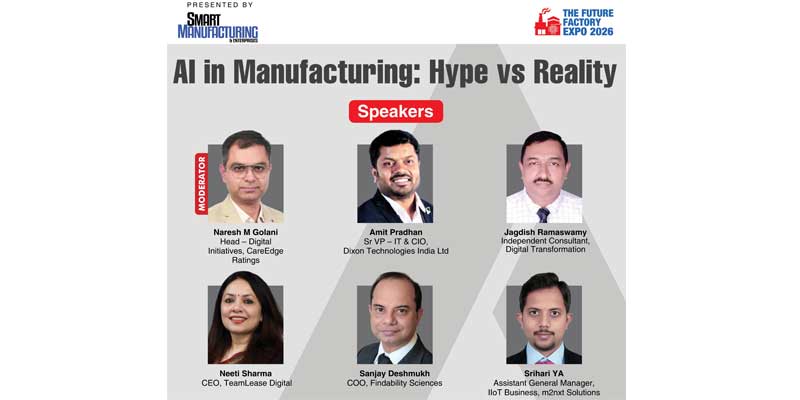
Future Factory Expo (FFE) recently hosted a webinar bringing together senior leaders from manufacturing, digital transformation and workforce development to decode artificial intelligence's role on ..
Read moreSmart Manufacturing
Future Factory Expo 2026 to Drive India’s Smart Manufacturing Shift
Organised by Smart Manufacturing & Enterprises (SM&E) and ASAPP Info Global Group, Future Factory Expo 2026 (FFE 2026) will bring together India’s manufacturing ecosystem to accelerate adoption of..
Read moreRelated Products

Fanless Industrial Pc for Smart Manufacturing
Smart Manufacturing
CONTEC Launches BX-M4600 Series - Fanless Industrial PC for Smart Manufacturing.
latest News
Subscribe to iNoW

For Industry News on WhatsApp, Give a Miss Call on: +91 84228 74016