





Schedule a Call Back


Building Robots for India’s Factory Floor
 Articles
- Jun 25,26
ANSCER Robotics journey reflects India’s ambition to build globally relevant automation from local industrial realities, writes Ashlin Rajan.
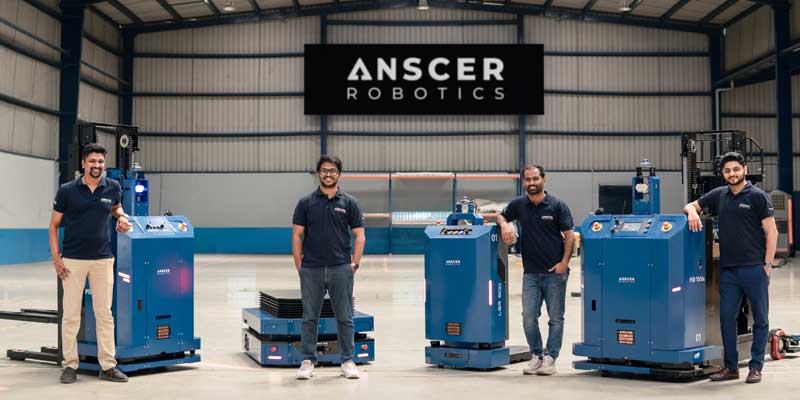
For Raghu Venkatesh, Cofounder and CBO, ANSCER Robotics, the company’s journey began with a question larger than any one product: what could India build for the world?
Around seven to eight years ago, India was beginning to speak with greater conviction about moving from a service-led economy to a producer economy. The push around Make in India and Atmanirbhar Bharat had created a new sense of possibility. That thought brought ANSCER’s co-founders together in 2017. Raghu Venkatesh, a software engineer, joined hands with Ebin Sunny, Raj Mohan and Ribin Matthew, who came from robotics engineering backgrounds. “We wanted to use our skill sets to build something in India that could be recognised globally,” said Raghu. Their ambition was clear: to use their skill sets to build something in India that could be recognised by the world.
A pandemic-era beginning
The first turning point came during the pandemic. In the Hack the Crisis challenge, organised by the Government of India, the World Bank and the European Union, the team explored a sustainable alternative to chemical sanitisation. They turned to UV-ray technology and built a robot that could carry UV light and autonomously clean hospitals, offices and malls.
The product was built in less than 50 days and won first place globally. The prize money helped the team buy more components and test whether the solution could be productised. In Bengaluru, the founders entered a hardware incubator, approached hospitals, and proved the concept with two or three early users. The feedback was encouraging, but the market also taught them a lesson: hospitals would not adopt such a product at scale unless the sanitisation method was supported by a published paper. By the time that could be pursued, Covid had passed, and the team began asking what they could build at scale.

Moving into manufacturing
That answer took ANSCER back to manufacturing. Venkatesh saw India’s ambition to become a global trade hub becoming more visible, but he also saw a gap. For India to manufacture more, export more and compete globally, it needed stronger supply-chain networks. Within that challenge, ANSCER identified a specific problem it could solve: material handling inside factories and warehouses.
The company’s core business today is built around autonomous mobile robots and an orchestration system that improve internal material movement. Its focus is not on replacing people, but on enabling people and robots to work together in complex industrial environments. Customers were struggling with a shortage of skilled labour for efficient material movement, especially where materials had to reach the right place at the right time without creating safety or process risks.
Designing for Indian factories
Designing for Indian factory conditions became central to ANSCER’s approach. Many Indian factories were built for people, not robots; older facilities were often congested, and operating conditions were different from globally benchmarked factories. ANSCER therefore had to re-engineer its navigation stack for Indian realities while building indigenous technology that met global safety standards.
ANSCER built its first customer-ready product in November 2021 and launched it on 16 December at Pragati Maidan. Initially, the founders expected warehouses to be the biggest opportunity. But at a warehouse trade show, more than 90 per cent of those approaching them with problems came from manufacturing. The insight reshaped the journey: the bigger problem lay in factories, where heavy parts and materials needed to move reliably every day.
Product platform
The product journey began with the AR series, developed as a platform rather than a single fixed product. The platform supports lifter, tugging, conveyor, robotic arm and pallet-stacker applications, allowing businesses to move materials in different ways. Through the AR series, ANSCER can handle loads from 250 kg to 1,250 kg.
As customers began asking for solutions in warehouses attached to factories, ANSCER developed its PSR series, launched last year. These robots can take material from trucks, store it in racks, retrieve it and deliver it to production lines, reducing human handling in between. The company is now looking at core warehouse solutions, with its next product focused on inbound and outbound warehouse operations.

Beyond the robot
What differentiates ANSCER is not only the robot, but the orchestration layer around it. The platform can integrate with WMS, MES, ERP systems, SAP or other systems, giving factories a unified interface. For workers, the experience is deliberately simple. Instead of building robots only for engineers, ANSCER created an interface that factory workers can learn in less than 10–15 minutes. “If one can solve problems in India, one can solve them anywhere,” points Raghu.
This simplicity translated into measurable operational value. In one deployment, workers could request material through the system and view arrival feedback similar to an Uber ETA. After around 100 days, the customer found that excess raw-material holding had reduced from 20 per cent to less than 5 per cent. The reconciliation process almost disappeared, warehouse space was freed up, and the customer told ANSCER it had achieved just-in-time movement after 10 years of trying.
Safety, scale and service
The company’s growth has not been without challenges. Its early multinational customers had strong safety expectations and told ANSCER that the machines had to meet European standards if they were to scale. When the products were first launched, they did not meet those standards. Building a robot that met global safety standards in less than a year became one of the company’s most important milestones.
“The focus is on enabling people and robots to work together for better outcomes,” Raghu. Scaling also required a shift in approach. Customers questioned how a young company could guarantee that its products would last for more than five years. ANSCER responded by working with system integrators and solution providers who already had market credibility, could validate the products and support implementation. During the 2022 chip shortage, critical parts had waiting periods of 54–56 weeks. ANSCER answered this with a modular architecture, with no soldering and plug-and-play components.
Expansion and market focus
Funding was another hurdle, with ANSCER contacting more than 150 investors before finding those who understood long-term change. Its recent funding round is intended to support expansion in North America and APAC.
Today, ANSCER has a dedicated 20,000 sq ft testing facility and production capacity of more than 1,000 robots. It sells in India and overseas, while keeping India as its primary market. So far, it has built solutions for electronics and automotive companies, and plans to focus on supply-chain companies, FMCG, white goods and aerospace. “The second differentiator is that the robots meet global safety standards while being made in India for the Indian market,” said Raghu.
The road ahead
From a pandemic-era sanitisation robot to autonomous material movement systems for manufacturing and warehousing, ANSCER Robotics has built its journey around a consistent idea: making robotics usable, safe and relevant for real industrial conditions. Its next phase will be shaped by warehouse-focused products, international expansion and a broader ambition to show that made-in-India robotics can serve both Indian factories and global markets.
ANSCER Robotics
Raghu Venkatesh
Ebin Sunny
Raj Mohan
Ribin Matthew
industrial automation
warehouse automation
manufacturing automation
made-in-India robotics
material handling robots
autonomous mobile robots
Ashlin Rajan
Related Stories
Automation & Robotics

SFK Group crosses Rs 1.5 billion annual turnover
SFK Group of Companies has crossed Rs 1.5 billion in annual business turnover, marking a key growth milestone as it expands across industrial automation, environmental monitoring, engineering soluti..
Read moreMachine Tools & Accessories
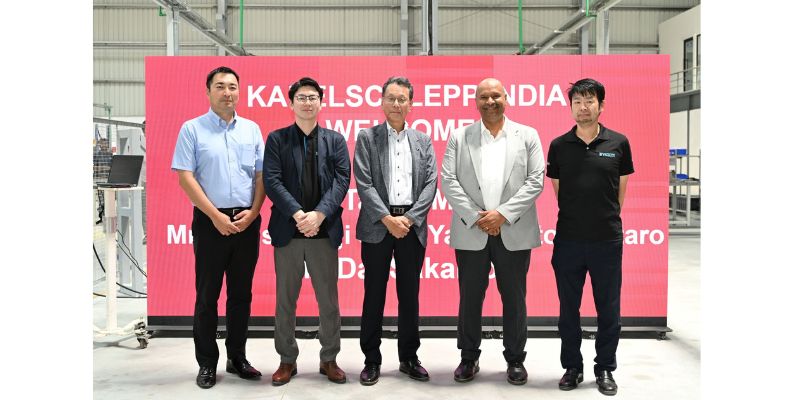
Tsubaki Leadership Reinforces India Growth Strategy during Kabelschlepp Visit
Tsubaki’s senior leadership visited Kabelschlepp India to review growth, localisation and innovation initiatives while strengthening engagement with employees, partners and customers.
Read moreAutomation & Robotics
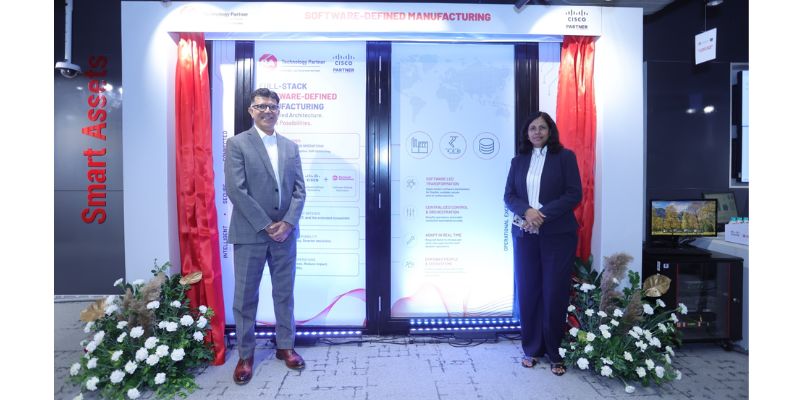
Rockwell Automation, Cisco Partner in India
Rockwell Automation and Cisco have announced a strategic collaboration in India to integrate IT and industrial automation, launch a software-defined manufacturing demo pod, and strengthen digital sk..
Read moreRelated Products
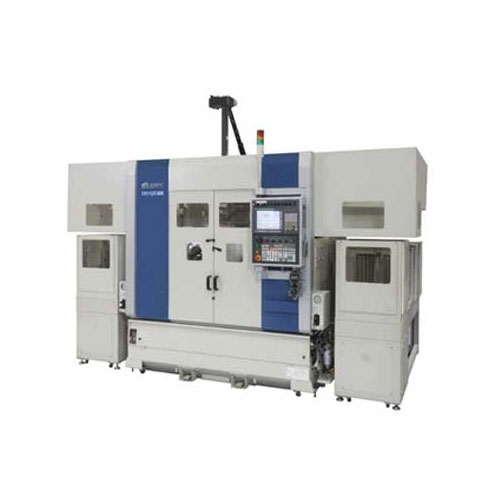
Compact Fmc - Motorum 3048tg With Fs2512
INDUSTRIAL AUTOMATION & TECHNOLOGY CONSULTANCY
Meiban Engineering Technologies Pvt Ltd offers a wide range of Compact FMC - Motorum 3048TG with FS2512.
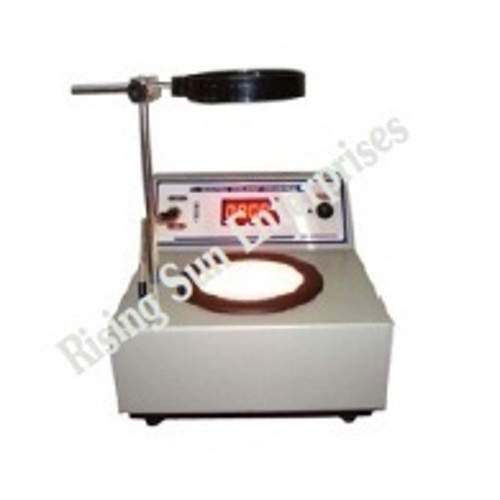
Digital Colony Counter
INDUSTRIAL AUTOMATION & TECHNOLOGY CONSULTANCY
Rising Sun Enterprises supplies digital colony counter.

Robotic Welding SPM
INDUSTRIAL AUTOMATION & TECHNOLOGY CONSULTANCY
Primo Automation Systems Pvt. Ltd. manufactures, supplies and exports robotic welding SPM.
latest News
Subscribe to iNoW

For Industry News on WhatsApp, Give a Miss Call on: +91 84228 74016