





Schedule a Call Back


OMC Power aims 1 GW target, to scale up BESS deployment: Rohit Chandra
 Articles
- Oct 30,25
In this interview with Rakesh Rao, Rohit Chandra, MD and CEO of OMC Power, highlights the role of the distributed renewable energy sector in driving India’s energy transition.

With a focus on solar energy and energy storage, the distributed renewable energy sector is transforming India’s energy landscape. Rohit Chandra, Managing Director and CEO of OMC Power, is at the forefront of this change, leading the company’s mission to bring distributed renewable energy solutions to the grassroots. OMC Power has set an ambitious 1 GW target to expand India’s decentralised renewable energy footprint, with total investment of approximately Rs 40 billion. In this interview with Rakesh Rao, Rohit Chandra highlights the sector’s role in driving India’s energy transition and OMC Power’s growth plans.
To set the context, please give us a brief on OMC Power.
OMC Power is focused on driving the energy transition at the grassroots. We design and deliver distributed renewable energy solutions that reach customers quickly, reliably, and cost-effectively. Our operations are organised into four lines of business:
1. Power for telecom infrastructure: We provide renewable energy solutions to telecommunication towers, helping operators reduce dependence on diesel and grid variability.
2. Institutional and commercial & industrial (C&I) rooftop solar: We develop rooftop and on-site solar solutions for institutional and commercial–industrial customers.
3. Energy access and distribution: We operate roughly 100 locations where we generate, store, and distribute electricity through our own local distribution networks.
4. Solar EPC: We execute turnkey solar EPC projects across multiple geographies.
In the medium term, our goal is to deploy one gigawatt of solar and renewable energy solutions across these four businesses. We are deliberately building a platform that is both scalable and financially prudent. On 31 July, we announced that OMC Power had become PAT-positive—one of the few companies in our segment to have crossed that profitability milestone. This performance provides a solid foundation to accelerate deployment.
From a governance and strategic perspective, OMC is professionally run and strongly supported by long-term, blue-chip shareholders from Japan. Mitsui & Co. invested in 2017 and has remained a steadfast partner. Chubu Electric Power, Japan’s third-largest energy utility, became a shareholder in 2022, invested again in 2024, and is currently our single largest shareholder. Our board reflects this depth: five of seven directors are Japanese, and both Mitsui and Chubu have representatives on the management team, ensuring an active, knowledge-rich partnership rather than a purely financial investment.
We are also pleased to share that Honda Motor Co., Japan has joined as a strategic shareholder. Honda’s entry is the culmination of a multi-year technical collaboration and strengthens our capability in energy storage—an area intrinsic to distributed renewable energy.
OMC’s strengths are design, engineering, product management, and systems integration. We typically follow build–own–operate models, operating the assets we develop. In our EPC business, we build and sometimes operate during the transition, while the asset is owned by the client. Across the platform we have completed about 150 installations, and the EPC segment is growing rapidly. We began with a heavy focus on MSMEs, crafting solutions that included not only engineering but also financing support and carbon-credit enablement. This has expanded to include larger corporates, but the principle remains: we deliver technically sound, bankable, and economically compelling projects.
Many players pursue utility-scale IPP projects. Why has OMC chosen distributed renewable energy?
There are broadly two routes to expand access to electricity. The top-down approach relies on large, centralised plants that feed the grid, which in turn reaches end-users. The bottom-up approach—distributed renewable energy—brings generation and storage closer to consumption, often behind-the-meter. India’s telecom sector offers a useful analogy: instead of a few massive exchanges, we built a network of hundreds of thousands of towers that enabled affordable, ubiquitous access. Distributed energy mirrors that logic for power.
The benefits are tangible. Customers—whether a telecom tower company, a university, a factory, or a hospital—receive a solution at their premises without waiting for grid upgrades. Capital is used more efficiently, losses are lower, and reliability improves. A current illustration is our project with the Government of Uttar Pradesh to solarise medical colleges and district hospitals across the state—around 165 facilities. Under a power purchase agreement (PPA), we install rooftop and on-campus solar assets, making these institutions significantly less dependent on the grid. A medical college often has 20–30 acres; installing 2–4 MW within the campus can cover a large share of demand at a tariff less than half of prevailing grid rates, with no upfront capex for the client since these are developed under a RESCO (build–own–operate) model with 25-year PPAs. This is a practical, grassroots energy transition.
How will the new partnership with Honda support your business? What exactly will it add?
Our relationship with Honda Motor is a long-term strategic partnership built over four years of joint research and development. Together we have worked on stationary storage systems, repurposing EV batteries, and the software and controls needed to integrate these assets at scale. We have conducted market and feasibility studies, developed hardware and software, and validated solutions with customer feedback.
Two business streams now follow from that groundwork.
- Second-life batteries for stationary use: EV batteries that complete around three years of automotive service still retain significant useful life—at least five years—for stationary applications. OMC and Honda will repurpose and redeploy these batteries at scale, using the hardware, battery management systems, and control software we have co-developed.
- New batteries for Battery Energy Storage System (BESS): We will also deploy new Honda battery systems across our distributed portfolio—rooftop C&I, MSME sites, telecom power solutions, and energy-access projects—thereby deepening our storage capability and cost competitiveness.
To execute this, OMC is establishing a dedicated battery and storage division. Honda will contribute not only technology and product but also two senior technical/R&D resources embedded within our management team. In turn, OMC provides market access through our one-gigawatt deployment ambition and our operating expertise in distributed energy. The partnership is another strong example of Indo–Japanese collaboration in clean energy. With Mitsui, Chubu Electric, and now Honda on the same platform, we are privileged to combine global trade, utility-scale energy know-how, and storage excellence.
Honda’s systems will support a new segment centred on repurposed EV batteries for stationary use—addressing the very large UPS/inverter-type market across urban, semi-urban, and rural India. Various estimates place the BESS market at around Rs 1 trillion today, with potential to grow to Rs 3 trillion in the medium term. We intend to participate meaningfully in that growth.
You mentioned a one-gigawatt deployment goal. Where are you today, and what is the ramp-up plan?
We are completing around 100 MW at present. Achieving PAT-positive status at this scale has given us the confidence—and investor support—to accelerate. We are actively securing PPAs across multiple states and expect a pipeline of roughly 500 MW within this year. Our outlook is to reach one gigawatt across our formats in about three years, subject to normal execution contingencies.
What level of investment is required to reach one gigawatt?
We estimate a total investment of approximately Rs 40 billion, financed through a prudent mix of equity and debt. On the equity side, we strengthened the balance sheet with a Chubu Electric round in October 2024 and now with Honda’s entry. On the debt side, we work closely with State Bank of India as our anchor lender, alongside other partners. We expect equity to constitute roughly Rs 12 billion of the total requirement, with the remainder in debt, deployed in line with project milestones and PPA tie-ups.
How do you enable MSMEs and SMEs to adopt renewables—both technically and financially?
MSMEs remain a priority. Many rely on a grid–diesel mix, which is expensive and volatile. Our approach is comprehensive: we deliver the engineering, help arrange financing, and—crucially—enable carbon-credit monetisation. For a typical MSME, we can structure a 3–5 year loan so that even during repayment, the net cash outflow on energy is around half of what it used to be; after the loan is repaid, the savings are obviously higher. This has a direct, positive effect on cash flows and competitiveness.
On credits, we have developed a robust MRV (monitoring, reporting, verification) process with foreign institutions that value the environmental, social, and economic impact of MSME decarbonisation. We install metering and remote monitoring, audit the data to quantify renewable generation and avoided emissions relative to coal/diesel baselines, and then act as the facilitator for credit issuance and payments. In a number of cases, MSMEs receive credit revenues for up to seven years, with realised prices up to $ 20 per MWh depending on the programme and vintage. This income is incremental to their tariff savings and helps de-risk adoption from day one.
The interest among MSMEs is extremely high. Initially, the driver is almost always economics—they can “touch and feel” the monthly savings. As credit monetisation flows begin, environmental stewardship becomes a reinforcing incentive. Larger corporates come with strong governance and compliance motivations as well, but economics still matters as a supportive outcome.
The principal barrier in the MSME segment is not enthusiasm but bankability: limited credit history, informal bookkeeping, or weak documentation. We therefore go beyond the kilowatt-hour to provide a bankability toolkit—standardised project documentation, performance guarantees where appropriate, digital metering, and auditable data trails that comfort lenders. This integrated approach—solution + finance enablement + credits—has proved decisive in converting intent into investment.
Bringing this together, how do you see OMC’s role in India’s energy transition over the next few years?
We view OMC as a platform company for distributed clean energy—combining project origination, engineering, storage integration, operations, and financing enablement. The one-gigawatt target is a practical anchor around which we are aligning our teams, partners, and capital providers. Our Japanese shareholders bring complementary strengths: Mitsui contributes global scale and commercial acumen; Chubu Electric brings deep utility expertise; and Honda adds advanced battery technology and second-life solutions. Together, we are well placed to expand distributed solar and storage across telecom, institutional/C&I, energy-access clusters, and a new second-life battery segment.
At the customer end, our promise is straightforward: lower, more predictable energy costs, delivered on-site, with no or limited upfront capex, supported by bankable PPAs, and enhanced through carbon-credit monetisation. For hospitals and colleges, this strengthens essential services; for MSMEs, it improves competitiveness and cash flow; for larger corporates, it advances ESG goals while delivering attractive paybacks.
Financial discipline remains central. We will sequence expansion against contracted PPAs, maintain prudent leverage, and continue to professionalise operations with rigorous data, monitoring, and controls. Storage will be the glue that binds distributed assets into reliable, flexible systems. With Honda’s partnership, we expect to improve performance, reduce lifecycle costs, and scale BESS deployments efficiently—including second-life applications that extend battery utility and reduce waste.
In short, OMC’s next phase is about scaling with discipline—turning distributed renewable energy and storage into a mainstream, high-reliability utility service at the customer’s doorstep, while supporting India’s broader decarbonisation and industrial growth objectives.
4 Blurbs
Various estimates place the BESS market at around Rs 1 lakh crore today, with potential to grow to Rs 3 lakh crore in the medium term. We intend to participate meaningfully in that growth.
For the MSME segment, we go beyond the kilowatt-hour to provide a bankability toolkit—standardised project documentation, performance guarantees where appropriate, digital metering, and auditable data trails that comfort lenders.
To reach one gigawatt, we estimate a total investment of approximately Rs 40 billion, financed through a prudent mix of equity and debt.
Honda’s systems will support a new segment centred on repurposed EV batteries for stationary use—addressing the very large UPS/inverter-type market across urban, semi-urban, and rural India.
Rohit Chandra
OMC Power
Distributed renewable energy
Telecom energy solutions
Energy access
Solar EPC
Energy storage
Honda Motor
MSME energy solutions
India energy transition
Mitsui & Co
Chubu Electric
Honda Motor
Related Stories
Electrical & Electronics
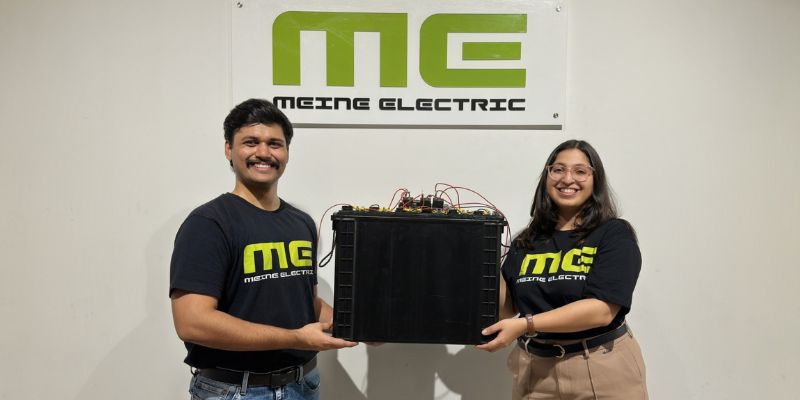
Meine Electric Develops Fast-Charging Iron-Air Battery System
The independently validated system charges in six hours and discharges over 18 hours, targeting daily renewable energy balancing and long-duration storage applications.
Read moreElectrical & Electronics
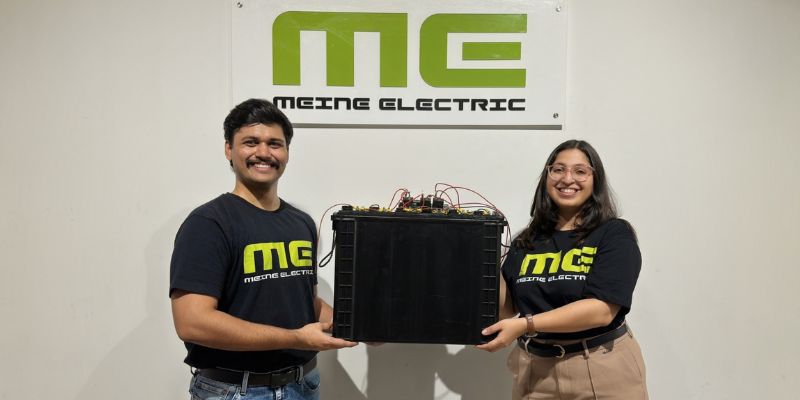
Meine Electric Develops Fast-Charging Iron-Air Battery System
The independently validated system charges in six hours and discharges over 18 hours, targeting daily renewable energy balancing and long-duration storage applications.
Read moreAuto & Auto Components
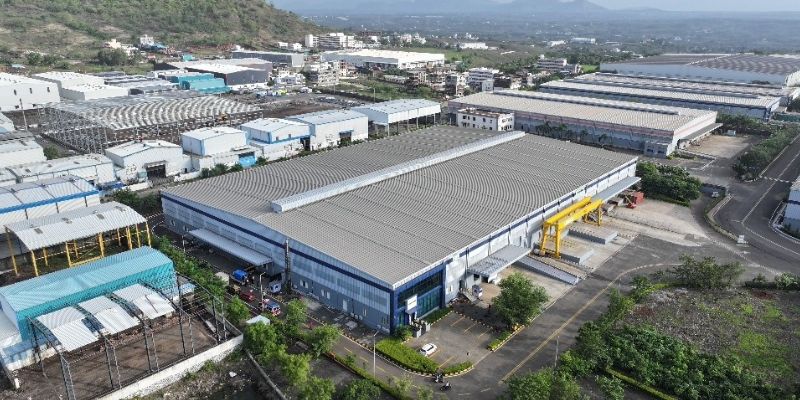
AmpereHour Opens 5 GWh BESS Manufacturing Facility in Pune
The Chakan facility will integrate Make in India battery blocks and digitally validated energy storage systems for utility-scale and industrial applications.
Read moreRelated Products

Ultra-slim Humidity/temperature Indicator With Large 4” Display
ELECTRICAL & ELECTRONIC EQUIPMENT
Countronics offers a wide range of ultra-slim humidity/temperature indicator with large 4” display – Model 7100-4W.
Read more
Integrated Electric Gripper S Series
ELECTRICAL & ELECTRONIC EQUIPMENT
IBK Engineers Pvt Ltd offers a wide range of integrated electric gripper S series.

Geared Electric Motors
ELECTRICAL & ELECTRONIC EQUIPMENT
Delco Fans Pvt Ltd offers single phase capacitor run and three
phase geared Instrument motors, totally enclosed face/foot mounted.
latest News
Subscribe to iNoW

For Industry News on WhatsApp, Give a Miss Call on: +91 84228 74016