





Schedule a Call Back


India’s electronics growth is accelerating rapidly: Chris Mitchell
 Articles
- May 25,26
The Global Electronics Association, formerly IPC, has over 3,200 member companies worldwide and a growing presence in India and Southeast Asia. In this interaction with Ashlin Rajan, Chris Mitchell, Vice President – Global Government Relations, Global Electronics Association, emphasises India’s potential as a hub for electronics design, manufacturing, and advanced system-level packaging.

Could you briefly introduce the Global Electronics Association and its larger mission in supporting the global electronics ecosystem across policies, standards, certifications, market intelligence and member engagement?
The Global Electronics Association was founded in 1957, originally as IPC. We rebranded last year. The Association has more than 3,200 member companies globally, and our membership in Asia, India and Southeast Asia has been growing rapidly.
Historically, we have probably been best known as a standards development organisation. Approximately 90 per cent of high-reliability electronics manufactured globally are, at some point in the process, manufactured to one of our standards.
We are also the world’s largest source for credentialing and training for our industry. We credential over 140,000 people per year to work in electronics manufacturing. If you go into a printed circuit board facility or an electronics manufacturing services facility, you will often see the Association or IPC credentials for the individuals who work there.
That area of our work with industry is growing rapidly. While we continue to certify around our standards, we are also leading an ambitious effort with industry to create job role-related training for our industry. This training is portable and stackable, and ensures that individuals credentialed in one part of the world have the skillset to perform work in any part of the world.
That is a huge area of excitement for us, and I think it is an area where there has been very strong industry demand.
In addition, I oversee our industry intelligence and advocacy programmes. We see both these programmes as critical to supporting not just the growth of the industry, but also supply chain resilience. We bring a multifaceted approach to supply chain resilience.
In today’s world, which is characterised by geopolitical tensions and significant changes within the industry on both the business and technology sides, we believe supply chain resilience has to be a very high priority for all companies. Our focus is to ensure that we are supporting them as they make business decisions around the world.
To that end, we believe in providing industry insights and data to help companies make business decisions. Moreover, we believe it is imperative that we work closely with industry to educate and engage government leaders, so that policies promote investment and safeguard access to the global supply chain.
With supply chains being reshaped by geopolitical pressures, trade shifts and regional manufacturing strategies, how do you assess the current state of the global electronics industry?
Certainly, geopolitical tensions and trade issues have put a certain strain on the global industry. Much of that strain is related to uncertainty. A lot of companies are always trying to define where the right place to invest is at any given moment, while understanding that the decisions of a government can dramatically alter the wisdom of that investment.
To governments, we have been emphasising the importance of greater certainty so that companies can make good business decisions.
That being said, the industry is growing. We are obviously seeing rapid growth around certain sectors, including AI, and that is fuelling demand for electronics. Electronics today are critical to every vertical of our economy, and that trend is only continuing to accelerate.
From that perspective, this is a good period of growth for the industry. However, for individual companies, even though the growth is robust for the industry as a whole, they need to be cognisant of where they are investing and how that fits into their larger business strategy.
As electronics manufacturing becomes more technology-intensive, what skills and engineering capabilities will be most important for countries like India to build global competitiveness?
I would begin with the assertion that every country should have a robust electronics strategy. Countries need to be intentional about the segments of the industry in which they would like to demonstrate leadership, while also understanding that the ultimate goal is to be able to build electronic systems.
In the past, I think it was far easier for countries to think in isolated ways about demonstrating leadership within the industry. That is still the case to some extent. No country can do everything, and no company can do everything. There needs to be interdependence with the larger global marketplace.
That being said, it is more important than ever to be intentional about where countries want to invest and how that fits into their larger strategic goals. Different countries are going to have different strategies in terms of the areas they want to build, and not everyone is starting from the same baseline.
In India, we are seeing strong emphasis on continuing to build expertise around design. We have also seen tremendous investment in the printed circuit board industry, which to me is very exciting, especially as companies continue to diversify their supply chains.
As we look at certain verticals, AI has been driving a lot of investment in hardware manufacturing. The electronics for the AI industry are very sophisticated and require a certain level of capability. Countries are showing interest in ensuring that they have those capabilities in place to participate in the AI space in some form or another.
What role can globally accepted standards and certification frameworks play in helping India strengthen quality, reliability and trust in electronics manufacturing for global markets?
This is probably not as appreciated outside the industry as it is within the industry, but standards are built into contractual relationships, and the workforce needed to meet those standards is also built into contractual relationships.
As companies seek to qualify suppliers, they look to see whether those companies are manufacturing to those standards and whether they have the credentialed workforce to ensure that they can meet high-quality requirements.
From our perspective, so much begins with standards. It is hard to ensure quality and reliability across the global supply chain without having robust standards in place and without ensuring that you have the workforce to meet those standards.
Standards are foundational to our industry and to how our industry operates across the global supply chain.
What government policies or regulatory changes can further support Indian electronics manufacturing?
India has a tremendous interest across the industry in the advancements and growth of the industry here. We want to be a good partner to the government and to the industry as both take steps to grow the ecosystem in India. That is the mandate from our membership.
We understand that continuing to build this ecosystem requires addressing a number of different challenges, including workforce, technology, investment, R&D and sustainability.
We want to make sure that we are a strong partner to the government as it helps incentivise these investments in the country. We are excited about what is taking place here.
India is already a major hub for electronics design and electronics manufacturing. Every indication is that this will continue to grow dramatically. With that growth comes the need to have the right workers in place and the right kind of government regulations to support that growth.
We want to make sure there is a platform available for companies to continue to meaningfully engage with the government. That is why we are here, and that is why we are working with companies.
How do you view India’s current manufacturing and engineering maturity, and what are the most critical capability gaps it must address?
The good news is that India is now in a position to meet those standards. There are many large companies and several companies in India that are already very familiar with our standards and workforce programmes. They have already integrated those standards into their own manufacturing operations and ensured that they have the credentialed workforce in place to meet customer requirements.
From that perspective, there is already a strong reliance on our standards across the industry in India. Obviously, we are always looking to ensure greater awareness of our standards and to work with companies, especially new companies, to improve their own manufacturing so that they can meet those requirements and have the credentialed workforce in place.
That is a good news story to tell. It is partly because of the awareness we bring to these standards, but the reality is that a lot of the awareness of our standards comes through customers. They have built these standards into their requirements. Companies understand that if they want to participate in the global marketplace and serve a global customer base, they need to integrate these standards into their operations and ensure they have the skilled workforce in place.
Because technology continues to advance, there is a greater need for companies globally to not only meet those standards but also help shape them.
As we continue to develop our standards globally, there is a huge emphasis on making sure that companies in India are not just using our standards, but are also helping to shape them. That is an area where I feel there is a substantial opportunity for companies in India to play a bigger role.
What policy, regulatory or industry-level measures would be most important for India to move deeper into the global electronics value chain?
As I alluded to earlier, we are seeing many changes across the supply chain. Diversification is becoming an increasingly important priority, and we are seeing a lot of investment in India.
Much of this is driven in part by the PLI schemes, Make in India and other government programmes that have been put in place to incentivise investment. This is fantastic.
In India, there is a very strong electronics assembly sector. A lot of electronics design is taking place. We are seeing huge growth in the printed circuit board industry, and we would love to see those investments continue so that the boards manufactured here are among the most cutting-edge.
In addition, there is a huge opportunity in India to grow expertise and leadership around component manufacturing. That is an area I know is a high priority for India, and we expect to see continued investment.
What are the association’s future goals, and how do you see them supporting the global electronics industry in the next phase of growth?
We see explosive growth in the electronics industry, especially in some parts of the world, including India and Southeast Asia. As that growth takes place, it puts great pressure on ensuring that there is a skilled workforce in place and infrastructure to support that growth.
That is one of the areas where we feel we can be a good partner, not just to industry, but also to government.
There are a number of other issues as well. We see significant issues around sustainability, not just in terms of eco-design and standards around manufacturing, but also in terms of reporting across the supply chain. We are very active on those issues.
In addition, there are several technology issues where we are working very closely with industry globally to ensure that the next generation of standards is in place. This is needed to support not just component-level manufacturing, including semiconductor advanced packaging, but also to ensure that the right standards are in place so that those components can be placed on printed circuit boards by electronics manufacturing services companies and OEMs.
We have seen incredible advancement in semiconductor technology, and those advancements drive progress across the entire electronics supply chain. That is not always well appreciated. As we drive advancements in semiconductor technology, we need to make sure there is sufficient investment going into other parts of the supply chain to ensure that we can build the next generation of electronic assemblies.
That is an area where we are heavily focused: making sure there is system-level packaging and advanced system-level packaging to complement advancements in component-level packaging. This means investment not only in facilities, but also in standards, workforce and other areas.
Global Electronics Association
IPC rebrand
electronics manufacturing
workforce credentialing
supply chain resilience
India electronics hub
global standards
electronics industry growth
AI hardware manufacturing
Chris Mitchell
Related Stories
Automation & Robotics
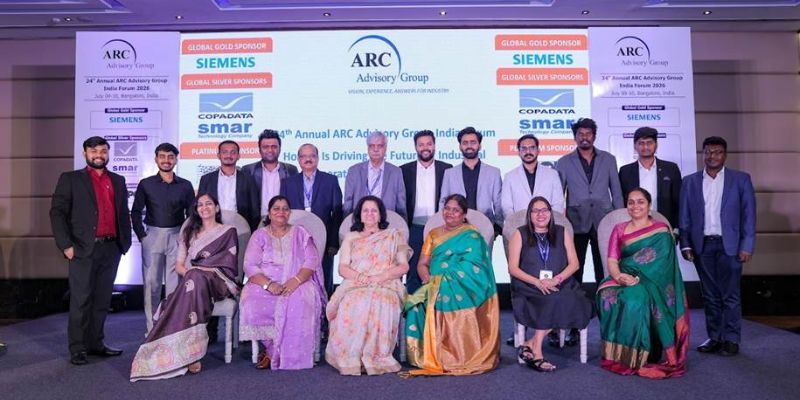
ARC India Forum Spotlights AI-Led Industrial Transformation
ARC Advisory Group’s 24th India Forum brought together 300-plus leaders to examine how AI is transforming industrial operations, manufacturing and supply chains.
Read moreElectrical & Electronics
IESA Backs Rs 625 billion PLI 2.0 for Electronics Manufacturing
IESA has welcomed the Rs 625 billion PLI 2.0 scheme, citing its potential to sustain manufacturing growth and advance India’s US$400 billion electronics goal.
Read moreSmart Manufacturing

Hitachi Vantara’s Norman Plant Named WEF Lighthouse Facility
Hitachi Vantara’s Norman manufacturing site has earned WEF Lighthouse status for using AI to reduce lead times, inventory and carbon emissions.
Read moreRelated Products

Ultra-slim Humidity/temperature Indicator With Large 4” Display
ELECTRICAL & ELECTRONIC EQUIPMENT
Countronics offers a wide range of ultra-slim humidity/temperature indicator with large 4” display – Model 7100-4W.
Read more
Integrated Electric Gripper S Series
ELECTRICAL & ELECTRONIC EQUIPMENT
IBK Engineers Pvt Ltd offers a wide range of integrated electric gripper S series.

Geared Electric Motors
ELECTRICAL & ELECTRONIC EQUIPMENT
Delco Fans Pvt Ltd offers single phase capacitor run and three
phase geared Instrument motors, totally enclosed face/foot mounted.
latest News
Subscribe to iNoW

For Industry News on WhatsApp, Give a Miss Call on: +91 84228 74016