









Schedule a Call Back


Cobot Shipments Set to More Than Double by 2030
 Industry News
- Jun 15,26
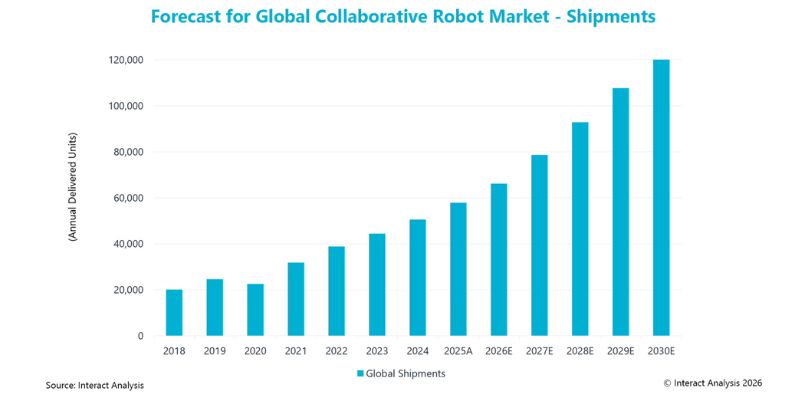
Global collaborative robot shipments reached nearly 58,000 units in 2025 and are forecast to more than double from 2026 to 2030, led by China’s rising dominance.
The collaborative robot market is entering a phase of
sustained but uneven growth. The latest Collaborative Robots – 2026 report
points to a market that is maturing in pricing, while remaining volatile in regional
and application demand.
Collaborative robot shipments reached nearly 58,000 units in
2025, growing 14.5 per cent over the previous year. Shipments are forecast to
more than double over the five-year period from 2026 to 2030.
Growth, however, is not expected to follow a smooth upward
trajectory. The report identifies two cyclical peaks during the forecast
period. Growth is predicted to slow slightly in 2026 before accelerating to a
higher level in 2027, sustaining strong momentum through 2028, easing again in
2029, and reaching another peak in 2030.
This pattern reflects industry investment cycles,
technological iteration, and changes in downstream demand. The forecast growth
rate from 2025 to 2030 is significantly higher than the average recorded
between 2019 and 2024, driven by an accelerated market penetration phase.
Revenue growth for collaborative robots is also expected to
remain strong, but will trail shipment growth due to a gradual decline in
average selling prices (ASP). Global collaborative robot revenue is projected
to increase from $1.2 billion in 2025 to $2.4 billion in 2030, representing an
average annual growth rate of approximately 14.7 per cent.
Unlike the sharp price erosion seen in recent years,
particularly during the intense price wars from 2021 to 2024, ASP declines from
2025 onward are expected to be more moderate.
Three structural factors explain this moderation. First,
price reductions from Chinese vendors are slowing as the intense domestic price
war stabilises and suppliers shift focus from volume to value. Second, rising
manufacturing costs in Europe and the United States, including labour, energy,
and regulatory compliance, are putting a floor under pricing. Third, the
product mix is gradually shifting towards higher-payload models of 15 kg and
above, which command premium prices and help offset downward pressure from
entry-level segments.
As a result, while ASP continues to decline, the pace is
expected to be noticeably gentler than in the immediate post-pandemic years.
The most pronounced structural change in the collaborative
robot market is China’s steady rise as the global leader in shipment volume.
China’s share of worldwide unit shipments has grown substantially over the past
few years, from less than one third in 2018 to more than half by 2025.
China’s year-on-year growth rates have consistently outpaced
other major regions, frequently exceeding 20 per cent. The country is projected
to account for nearly two thirds of the global market by 2030.
In contrast, both the Americas and EMEA are experiencing
structural share erosion. The Americas’ share of the collaborative robots
market has declined significantly since 2018 and is expected to fall further by
2030. EMEA’s decline has been even sharper, dropping from a dominant position
in 2018 to a much smaller share in 2025, with further contraction ahead.
While both regions are forecast to see modest growth
acceleration from 2026 onward, this recovery is not sufficient to regain lost
market share. Key constraints include higher manufacturing costs and slower
adoption among small and medium-sized enterprises.
India remains a small but fast-growing niche market. Its
share stood at only 1.9 per cent in 2025 and is projected to reach 2.3 per cent
by 2030. However, India’s year-on-year forecast growth rates are consistently
above 20 per cent from 2026 onward, indicating future potential from a very low
base.

Material handling and assembly remain the two largest
revenue-generating applications for collaborative robots. In 2025, these two
segments together accounted for nearly half of the global market, with material
handling contributing the larger share.
Welding, despite having a smaller revenue footprint,
recorded the strongest growth among all applications, driven by the cyclical
recovery in the automotive and machinery sectors.
Testing and inspection-related applications also showed
strong momentum, with quality inspection, lab analysis, and sorting posting
solid growth. These trends highlight the continued integration of collaborative
robots with machine vision and advanced sensing technologies across
inspection-intensive tasks.
Between 2025 and 2030, the global collaborative robot market
is expected to see a doubling of shipment volumes, sustained revenue expansion,
and a moderating decline in average selling prices, rather than a sharp drop.
Market participants should prioritise growing demand for
high-payload models, address cost pressures in Western manufacturing regions,
and adapt to the revised pricing strategies of Chinese suppliers.
Humanoid robots represent an emerging downstream application
and are likely to provide additional incremental headroom in the medium to long
term. However, within the current forecast horizon, they will remain a modest
segment of the overall market.
collaborative robots
cobots market
robot shipments
industrial automation
China cobots
material handling robots
assembly automation
humanoid robots
Related Stories
Automation & Robotics

Yaanendriya Raises Rs 150 million to Scale Indigenous Navigation Systems
The deep-tech company will strengthen R&D, accelerate product development and expand high-precision navigation systems for mission-critical applications.
Read moreOther Industrial Products

Taiwan Excellence showcases AI-powered manufacturing solutions at Automation Expo 2026
Taiwan Excellence showcased 55+ industrial innovations from 22 Taiwanese brands at Automation Expo 2026, highlighting AI-driven solutions for India's smart manufacturing growth.
Read moreAutomation & Robotics

US bans foreign-made humanoid robot imports; may impact Chinese manufacturers
US restrictions on foreign-made humanoid robots raise questions for global robotics growth, with analysts warning of possible impacts on competition, scaling and commercialisation.
Read moreRelated Products
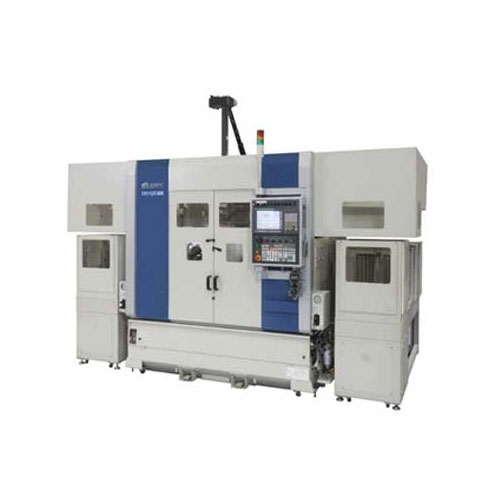
Compact Fmc - Motorum 3048tg With Fs2512
INDUSTRIAL AUTOMATION & TECHNOLOGY CONSULTANCY
Meiban Engineering Technologies Pvt Ltd offers a wide range of Compact FMC - Motorum 3048TG with FS2512.
Digital Colony Counter
INDUSTRIAL AUTOMATION & TECHNOLOGY CONSULTANCY
Rising Sun Enterprises supplies digital colony counter.

Robotic Welding SPM
INDUSTRIAL AUTOMATION & TECHNOLOGY CONSULTANCY
Primo Automation Systems Pvt. Ltd. manufactures, supplies and exports robotic welding SPM.
latest News
Subscribe to iNoW

For Industry News on WhatsApp, Give a Miss Call on: +91 84228 74016