





Schedule a Call Back


AI to Reshape Industrial Robot Demand and Capabilities
 Industry News
- Jun 09,26
AI is creating new demand for industrial and collaborative robots while improving their capabilities, ease of use and adoption across manufacturing sectors.
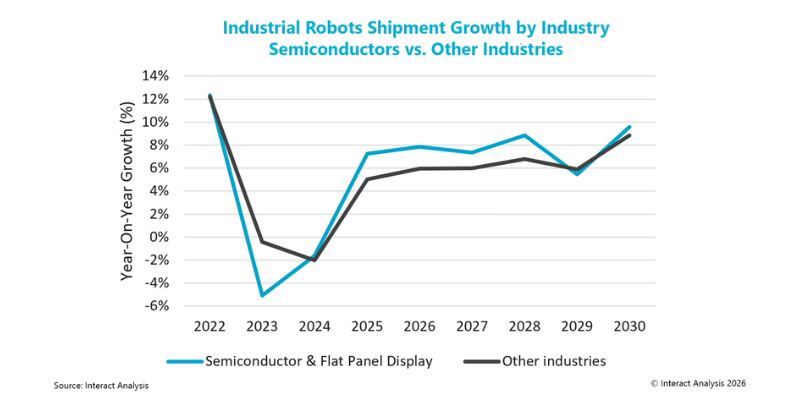
The global industrial robot market began recovering in 2025, with shipments growing 5.1 per cent and revenue rising 0.8 per cent, driven primarily by Asian markets. Over the next five years, the market is expected to grow steadily as robots are adopted across more manufacturing processes and emerging industries, while AI-related applications create new sources of demand.
AI is influencing robot demand in two key ways. First, the expansion of AI supply-chain industries is generating direct demand for robots in manufacturing. Second, AI-powered software is improving robot capabilities and ease of use, enabling robots to perform tasks that were previously difficult and creating demand in markets that were harder to penetrate.
In semiconductor manufacturing, AI-driven chip demand is accelerating automation. Robot sales to the semiconductor industry are predicted to grow at an average annual growth rate of 7.8 per cent through 2030, outpacing most other sectors. Light-payload articulated and SCARA robots are expected to be the main beneficiaries, while mobile collaborative robots used for wafer handling are also gaining traction. Demand for these mobile cobots is concentrated in Asia, particularly Taiwan, mainland China and South Korea. Key suppliers in this segment include Universal Robots, Fanuc, Techman and Jaka.
In data centre equipment manufacturing, the production of AI data centre equipment, from server cabinets to printed circuit boards, is driving robot demand across the supply chain. Alongside traditional industrial robots, collaborative robots are increasingly being used for inspection and component handling, valued for their flexibility and ability to work alongside people.
Humanoid robot manufacturing is also emerging as a customer segment for cobot vendors. In China, some emerging humanoid robot companies are focusing on software development while sourcing hardware off the shelf. Cobot vendors serving this market include Rokae, Jaka and Fairino.
AI is also making robots more capable and easier to use. This is significant because programming and integration complexity remain among the most frequently cited barriers to robot adoption. Recent Voice of Market research found that integration complexity was the top obstacle to automating material transport in factories, ahead of upfront cost concerns.
Four key areas of AI application in robotics are becoming visible: AI-powered machine vision for robot guidance, AI-enabled robot instruction and programming, AI-driven path optimisation and multi-robot coordination, and emerging applications in remote robot monitoring and maintenance.
AI allows robots to understand and respond to human language and supports low-code or no-code programming, making them easier to use. It also enables robots to handle complex tasks in flexible environments. For example, Fanuc demonstrated AI-powered dual control of two cobot arms sorting cables, a task traditionally difficult for robots. It also showcased AI-powered robots tracking moving parts for precision tasks such as screw tightening, underlining AI’s potential to improve robot adaptability.
However, AI-driven robotics remains at an early stage. It faces challenges such as cybersecurity risks in remote monitoring, limitations of low-code programming for complex tasks and high R&D costs for AI-enhanced software. Broad commercialisation will take time and depend on further innovation, as well as proven value across a range of industrial applications.
Industry leaders are actively capitalising on opportunities created by advances in AI. Robot manufacturers are launching new solutions tailored to electronics and semiconductor industries. For example, ABB introduced its Lite+ small robot series in 2025, identifying electronics as one of its key target sectors, while STEP recently launched dedicated wafer handling robots.
Robot vendors are also increasingly integrating AI capabilities into their products to improve performance, flexibility and ease of use. Universal Robots and Fanuc have both announced collaborations with NVIDIA to develop AI-powered robot programming and simulation tools.
These developments reflect manufacturers’ efforts to address key barriers to robot adoption, particularly the challenges linked to integration and programming.
AI is proving to be both a demand driver and a capability multiplier for the robotics industry. The expansion of semiconductor and data centre manufacturing is creating a strong new customer base, while AI-powered software is gradually lowering the integration barriers that have historically limited robot deployment beyond highly structured environments.
To capture these opportunities, robot manufacturers are investing in tailored solutions for AI-related industries while embedding AI into existing products. Ongoing discussions with industry participants will continue to track the commercial adoption of AI-powered robots and assess how AI shapes the broader growth story of the robotics market.
industrial robots
collaborative robots
AI robotics
semiconductor automation
data centre manufacturing
robot programming
mobile cobots
smart manufacturing
Interact Analysis
Related Stories
Automation & Robotics

Future Factory Expo CXO Roundtable Charts Smart Transformation for SMEs
During the roundtable, hosted by Smart Manufacturing & Enterprises (SM&E) and The Future Factory Expo 2026, industry leaders outlined how SMEs can use practical digitisation, automation, skilling an..
Read moreAutomation & Robotics

ARC India Forum Spotlights AI-Led Industrial Transformation
ARC Advisory Group’s 24th India Forum brought together 300-plus leaders to examine how AI is transforming industrial operations, manufacturing and supply chains.
Read moreSmart Manufacturing

Hitachi Vantara’s Norman Plant Named WEF Lighthouse Facility
Hitachi Vantara’s Norman manufacturing site has earned WEF Lighthouse status for using AI to reduce lead times, inventory and carbon emissions.
Read moreRelated Products
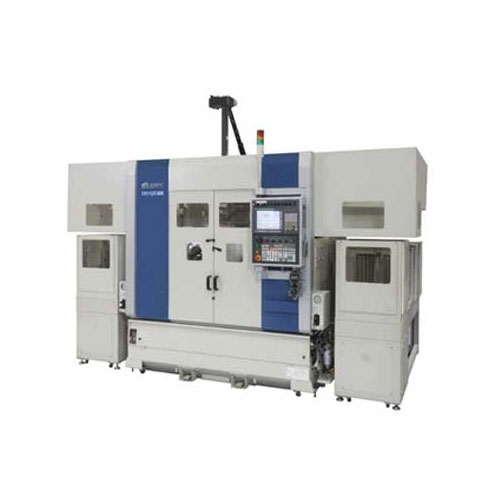
Compact Fmc - Motorum 3048tg With Fs2512
INDUSTRIAL AUTOMATION & TECHNOLOGY CONSULTANCY
Meiban Engineering Technologies Pvt Ltd offers a wide range of Compact FMC - Motorum 3048TG with FS2512.
Digital Colony Counter
INDUSTRIAL AUTOMATION & TECHNOLOGY CONSULTANCY
Rising Sun Enterprises supplies digital colony counter.

Robotic Welding SPM
INDUSTRIAL AUTOMATION & TECHNOLOGY CONSULTANCY
Primo Automation Systems Pvt. Ltd. manufactures, supplies and exports robotic welding SPM.
latest News
Subscribe to iNoW

For Industry News on WhatsApp, Give a Miss Call on: +91 84228 74016