






Schedule a Call Back


India’s Journey to 2047: Building a Balanced, Future-Ready Self-Reliance Model
 Articles
- Dec 02,25
India’s pursuit of a balanced, future-ready model of self-reliance, as examined by Subramanian Chidambaran, Chief Strategy Officer, Cummins India hinges on strengthening energy, food systems and strategic sectors to sustain long-term competitiveness.

The Honourable Prime Minister’s vision of Atmanirbhar Bharat continues to emphasise responsible self-reliance, reflect on how India can pursue it with clarity, balance, and a global outlook. The idea is not about turning inwards or rejecting interdependence but about reflecting on what responsible self-reliance means for India today and how it can be pursued with clarity and balance.
No individual, community, or nation can be completely self-sufficient. Our lives are connected through people, resources, and systems, and this interdependence forms the foundation of society. The challenge is to ensure that dependence does not create inequality, where the provider feels superior and the receiver inferior. True self-reliance lies in building capacities that reduce vulnerability while preserving dignity.
India is moving rapidly towards becoming the world’s third-largest economy. The country has a young, educated population, rising per capita income and an expanding middle class. Stable governance and improving ease of doing business are attracting investments. This convergence creates a rare opportunity for India to build self-reliance that is confident, pragmatic and future-ready.
Aspiring to self-reliance in every sphere is neither realistic nor necessary. It is therefore important to prioritise areas that matter most. A simple framework divides them into two categories:
- Needs essential for sustenance – Such as food, health, education and defence. These are critical for the survival and well-being of the population.
- Needs critical for growth – It includes energy and talent. These are necessary to support development, innovation, and long-term economic progress.
Energy: Powering Development with Indigenous Solutions
India’s energy demand is set to grow exponentially over the next decade. While renewable energy capacity has expanded significantly, it alone is unlikely to meet this demand. Much of the renewable energy value chain is local, yet the country still depends on imports for key components such as polysilicon wafers. A larger share of renewables in the grid could also create instability, requiring additional mechanisms to manage it.
Hence, the self-reliant strategy should focus on these three key areas:
1. Energy efficiency across the value chain: Generation, transmission, distribution, and consumption must be optimised. Industry and academia should be incentivised to develop practical solutions, energy-intensive processes analysed, inefficient technologies discouraged, and infrastructure upgraded to prevent losses. Efficiency should become the key metric of sustainability.
2. Maximising indigenous renewable energy potential: Solar energy should be prioritised, followed by hydro, wind and tidal sources. Integration of solar across the upstream value chain and research to improve conversion efficiency must be promoted and incentivised.
3. Developing robust energy storage solutions: Since solar is not continuously available, ensuring round-the-clock energy supply requires the indigenisation of batteries and green hydrogen technologies. Government, industry and academia must collaborate on clear roadmaps, prioritising solutions that enhance energy independence and deprioritising those that do not.
Food: Ensuring Security and Reliable Consumption
Food security remains a fundamental aspect of self-reliance. India is naturally blessed with fertile soil and favourable climatic conditions, yet rapid population growth and unplanned development have reduced arable land and forests, posing serious risks to food security.
A self-reliant food strategy should focus on six key areas:
1. Protecting existing land: Safeguard arable and forest land with stringent laws and strict enforcement, preventing misuse driven by corruption or self-interest.
2. Promoting research and innovation: Increase food production in smaller land areas while addressing the talent gap in agriculture through targeted programmes and incentives.
3. Improving efficiency across the food value chain: Upgrade storage, transportation and handling infrastructure. Analyse food-intensive processes, minimise wastage, and reduce dependence on middlemen who create artificial scarcity and inflate prices.
4. Encouraging responsible consumption: Raise awareness about reducing food waste in homes, restaurants and hotels, and additionally introduce strong penalties for avoidable wastage.
5. Ensuring equitable distribution: Facilitate private and public initiatives to purchase and distribute food fairly across society, guided by principles of responsible consumption.
6. Promoting indigenous food: Strengthen preference for locally produced foods over imported items, leveraging India’s rich and diverse culinary heritage.
The Way Forward
While energy and food are two critical areas, other sectors need attention, too. Bringing these together into a comprehensive Atmanirbhar strategy, supported by adequate funding, resources, and collaboration across government, industry and academia, will be essential. This approach will allow India to demonstrate true independence as it approaches the centenary of its freedom in 2047.
About the author:
Subramanian Chidambaran is the Chief Strategy Officer of Cummins India and also serves as Director of Global Corporate Strategy. He specialises in energy transition, leadership and long-term strategic planning. With prior roles at Siemens and McKinsey, he has driven major transformation and digitalisation initiatives across sectors.
Blurbs: (Use them if required) -- FOR PRINT
India is naturally blessed with fertile soil and favourable climatic conditions, yet rapid population growth and unplanned development have reduced arable land and forests, posing serious risks to food security.
A larger share of renewables in the grid could also create instability, requiring additional mechanisms to manage it.
India self-reliance
Responsible self-reliance
Sustainable growth
Energy security
Food security
Atmanirbhar
Cummins India
Cummins
Subramanian Chidambaran
Energy Transition
Related Stories
Electrical & Electronics

IESA Backs Rs 625 billion PLI 2.0 for Electronics Manufacturing
IESA has welcomed the Rs 625 billion PLI 2.0 scheme, citing its potential to sustain manufacturing growth and advance India’s US$400 billion electronics goal.
Read moreMaterial Handling Equipment
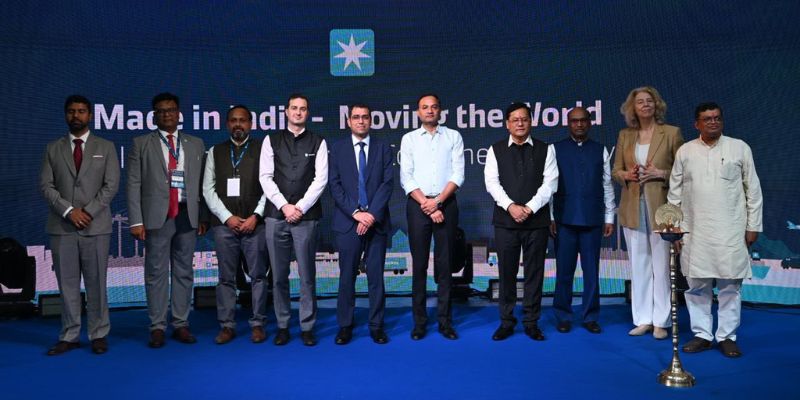
Maersk procures first India-made EXIM container
A.P. Moller – Maersk has become the first international shipping line to procure an EXIM container manufactured in India, with the inaugural unit unveiled at Dadri, Uttar Pradesh, in the presence ..
Read moreAerospace Defence

Merlinhawk Opens Advanced Composites Facility in Tamil Nadu
Merlinhawk Aerospace and Vega Composites have inaugurated an advanced composites facility at Shoolagiri to support aerospace and defence manufacturing in India.
Read moreRelated Products

Carbide Burrs
ABRASIVES & FINISHING EQUIPMENT
SRT Industrial Tools & Equipments offers a wide range of carbide burrs.

Jamshedji Soil Compactor
ABRASIVES & FINISHING EQUIPMENT
Jamshedji Constro Equip Pvt Ltd offers a wide range of jamshedji soil compactor.

Ground Pins
ABRASIVES & FINISHING EQUIPMENT
Hans Machineries Private Limited offers a wide range of pins, hardened & ground. Read more
latest News
Subscribe to iNoW

For Industry News on WhatsApp, Give a Miss Call on: +91 84228 74016