






Schedule a Call Back


How Autonomous Drones Are Redefining the Smart Factory
 Articles
- Jul 28,26
Ankit Kumar, Founder & CEO, Skye Air Mobility, explains how autonomous drones, Physical AI and real-time intelligence can help factories improve inspections, maintenance and operational decisions.
I do not run a factory. I run an autonomous logistics network in which drones, ground rovers and delivery ports work together as one system across some of the most crowded airspace on Earth. So far, the network has completed more than 4 million deliveries.
But every time I walk a modern plant, I recognise the problem I spend my days on. It is not "can the machine move?" We solved movement decades ago. The question now is quieter and harder: can the operation see what is happening and decide fast enough to act on it?
That is the real shift underway in manufacturing. For twenty years we automated tasks. The next decade is about autonomy. And the most mobile, most underrated instrument of that shift is a machine most people still file under "aerial photography" — the autonomous drone.
Automation ran the plant. Autonomy will read it.
Automation follows rules you wrote in advance. A line does the same thing, the same way, until someone stops it. That is rule-based execution, not intelligence, and it is enough right up until conditions change.
Autonomy is different. An autonomous system perceives its surroundings through computer vision, sensor fusion, and edge computing, and determines how to respond. It does not wait to be told a bearing is running hot. It notices, ranks the risk against everything else it is watching, and flags it.
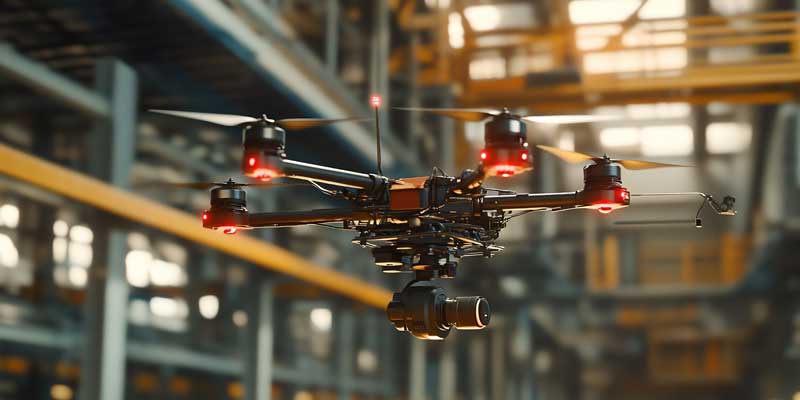
A drone is one of the cleanest ways to give a plant that kind of sight. It goes where fixed sensors cannot, sees what they miss, and moves. In our world, we call this Physical AI: hardware, autonomy, and intelligence working as one system instead of a box that flies. The same idea is walking onto the factory floor.
Why you send a drone, not a person
Inspection is still one of the most dangerous jobs in industry, and it stays dangerous because of gravity. Every roof, tank, flare stack, and gantry a person climbs to check is a version of that risk.
A drone does not climb. It flies the inspection. Fitted with high-resolution optics, thermal imaging, LiDAR, and vision models trained to spot defects, it detects corrosion, cracks, heat anomalies, and leaks on the same structures without putting anyone at height. Case studies from wind and infrastructure operators report inspections running up to 80 per cent faster this way, at a fraction of the cost.
The deeper change is not speed. It is frequency. When an inspection needs scaffolding, a shutdown, and a crew, you do it quarterly and hope nothing moves in between. When drones perform these inspections, facilities can inspect assets daily or continuously and catch a crack before it worsens.
The most expensive hour in a factory
Ask any plant manager what keeps them up, and it is rarely the planned stop. It is the one nobody saw coming.
Unplanned downtime remains one of manufacturing’s costliest operational risks, affecting output, delivery schedules and profitability. This is the single most expensive problem in manufacturing, and it is a sensing problem before it is a repair problem.
Maintenance used to be reactive, then preventive. It is now moving to predictive: fix the machine before it fails, on your schedule, not its. Deloitte's work on the smart factory puts the prize at a 10 to 20 per cent gain in equipment uptime and a 5 to 10 per cent cut in maintenance cost. Drones add a layer that fixed sensors cannot: they get eyes and thermal readings on assets a wired sensor was never bolted to, across the whole site, on a loop. Feed that visual and thermal data into the machine-learning models already watching vibration and current, and the plant gains earlier visibility into potential failures. The alert arrives days early, and the repair moves into a window you chose.
The warehouse that counts itself
Walk into most warehouses and inventory is still checked the way it was in 1990: a person, a scanner, a ladder, and a shutdown. Meanwhile, the count drifts, and a wrong count on a critical part can stall a whole line.
An indoor drone does not need GPS or a stopped facility. Using SLAM, computer vision, and onboard AI, it navigates the aisles on its own, scans barcodes and RFID, checks racks, and counts cycle stock overnight. Operators report accuracy in the high 90s, compared with 63 to 80 per cent for manual counts, at several times the speed.
Automation of this kind does not erase the warehouse job. It reshapes it. The drone is not replacing the employee who performs the count. It is doing the 2 a.m. count nobody wants, so the person can run the exceptions it finds.
One view of the whole plant
Most factories do not lack data. They lack a single view of it. The information sits in separate systems—ERP, MES, SCADA, quality platforms, maintenance software and IoT sensors—each producing valid data but rarely communicating effectively with the others.
I have learned this the expensive way in logistics: the hard part is never the aircraft. It is integration. How cleanly does the autonomous layer plug into the stack you already run? A drone earns its place here not by flying but by tying the physical plant back to the digital one, patrolling lines, watching material move, checking that what the dashboard claims is actually true on the floor. It turns a screen full of machine-generated numbers into something a supervisor can trust, because it is looking at the real thing.
The same technology also delivers sustainability benefits. According to the IEA, industry consumes close to 40 per cent of the world’s energy and produces roughly a quarter of global carbon emissions. Thermal drone inspections can identify heat leaking through roofs, failing insulation and overheating electrical panels. These inefficiencies eventually appear in both energy bills and emissions records. I am wary of sustainability as decoration. I prefer it as a number.
Physical AI, in the real world
The frontier here is not more software. It is software that can touch the world.
An autonomous drone is one of the most scalable forms of Physical AI a plant can deploy today. It already fuses perception, autonomy, and edge intelligence into a mobile body that does real work without a hand on the controls. We describe our own stack as one unified intelligent system rather than isolated hardware, and that phrase is the whole point. The value is not the drone itself. It is the intelligence the drone carries into places nothing else can reach.
The part nobody puts in the budget
The drone is not what will hold your factory back. The hardware itself is no longer the primary challenge. What remains unresolved is everything around it. Who governs the airspace inside your own plant when there are ten drones aloft at once? How do you know, in real time, which drones belong to the facility, which are authorised and where each is operating? How do findings from the vision system reach the maintenance team before the shift changes?
The same holds at the scale of one campus. A plant that puts autonomous drones in the air without a way to see and manage them in real time has not gained visibility. It has added a new operational risk that is difficult to monitor. This is why factories need a traffic-management layer before autonomous drone operations are scaled. Inside the factory, that unglamorous governance layer, not the aircraft, is what separates a pilot from a system.
None of this is a reason to wait. It is a reason to build the control layer alongside the drones, so that the organisation is prepared to move beyond the pilot stage when deployment expands.
Why this matters most from where I sit
India offers a particularly relevant setting for this discussion.
Around 2014, Make in India established a second ambition alongside that one: build things, not only code them. To be candid, the headline goal of raising manufacturing to 25 per cent of GDP has not yet been achieved; the real figure still sits near a sixth. But the mindset moved, and it moved where it counts. The small and mid-sized firms that produce close to half of India’s manufacturing output began to see what the country's own resources could actually build. AI, positioned at the centre of this shift, can act as a multiplier that turns the ambition into an advantage.
This is the market where autonomy meets its hardest test. India’s logistics costs are estimated at nearly 14 per cent of GDP, almost twice the global benchmark. If a system performs reliably in India’s heat, monsoons and densely populated environments, it holds up anywhere. That belief shaped how we built, and it is why I think the sharpest version of the smart factory may well be pressure-tested here first.
The race to build the factory of the future will not be won through a single breakthrough. It will be built where AI, robotics, Industrial IoT, edge intelligence, and autonomous flight are made to work as one loop. Within that loop, drones will serve as the plant’s most mobile sensing layer: watching, reading, and reporting what the fixed machines cannot.
So I will end where I started. The advantage in manufacturing is no longer how much you can automate. Everyone can automate. The advantage lies in how quickly an operation can detect change and decide how to respond, with your people and your autonomous systems in the same loop rather than in separate rooms. Plants that can detect and respond to change faster will gain a clear competitive advantage.
About the author:
Ankit Kumar is the CEO of Skye Air. As a seasoned consulting professional with strong knowledge in international corporate strategy, joint ventures, and Mergers & Acquisitions, he has also worked with several sectors across multiple locations throughout the years.
autonomous drones
Ankit Kumar
Skye Air Mobility
smart manufacturing
Physical AI
predictive maintenance
factory automation
industrial IoT
Related Stories
Smart Manufacturing

Lights-Out Manufacturing: The Future of Intelligent Circular Sawing
In this article, Prakhar Jain, CEO of the Indore-based ITL Industries Ltd, explains how the company is transforming metal cutting through smart automation.
Read moreSmart Manufacturing
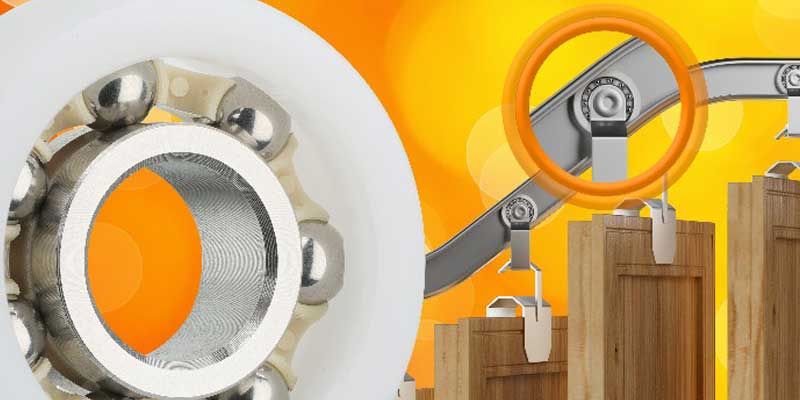
Igus Launches Hybrid Ball Bearings For Reliable, Dust-Resistant Conveyors
Igus develops maintenance-free hybrid ball bearing from the xiros series for dirt-resistant operation.
Read moreConstruction Equipment
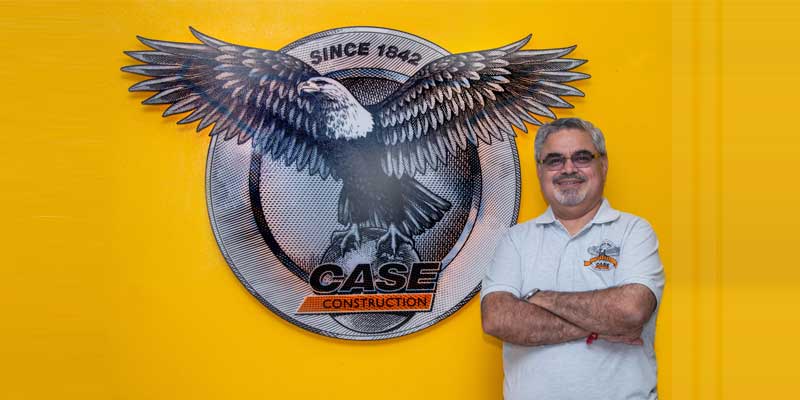
Future factories will integrate mechanical and digital tech: Sachin Tare
With manufacturing becoming increasingly technology-driven, Sachin Tare, Director – Manufacturing, CASE Construction Equipment, shares his perspective with Ashlin Rajan on automation, digitalisati..
Read moreRelated Products
Troop Comforts revolutionises military gear with indigenous innovations
Aerospace & Defence
Troop Comforts Ltd (TCL), a state-owned defence corporation, has recently received a request for proposal (RFP) from the Northern Command of the Indian Army for its indigenously developed military gea Read more
latest News
Subscribe to iNoW

For Industry News on WhatsApp, Give a Miss Call on: +91 84228 74016